

The Wall Control 4 ft. Metal Pegboard Organizer has a wall of five-star reviews and a stack of tidy photos to match them, and after mounting one in my own one-car garage and walking two clients through their own installs, I can tell you most of those photos were taken in week one, before the wall had a chance to tell anyone the truth. This is the honest version. The sharp edge I didn't expect until it caught my knuckle. The second box of hooks I didn't budget for. And the reason my client Odette, renting a duplex across town, probably shouldn't have ordered one at all. If you're standing in your garage right now deciding whether to buy this specific kit, this is the review I wish someone had written before mine showed up.
None of what follows is a case against the product. My own wall has held up fine for close to a year, and I still recommend this kit more often than any other garage system I own or sell clients on. But honest means telling you about the corner that cut me while I was reaching for a hacksaw, not just the neat rows of hooks in the listing photos. It also means telling you the parts that were genuinely a hassle to figure out on my own, since the instructions cover the mounting hardware in detail but stay quiet about almost everything that happens after the Wall Control panel goes up. So let's get into the parts the five-star reviews and the glossy photography leave out.
The Quick Verdict
A genuinely well-built metal pegboard system that earns its price once you go in knowing the real total cost, the sharp edges worth guarding against, and the storage problems it flatly won't solve for you.
Amazon Check Today's Price →Before You Order, Know What the Photos Don't Show
This system is real 22-gauge steel and it holds up. It also comes with a few real costs and real limits the listing never mentions. See today's price and current availability before you decide.
Amazon Check Today's Price on Amazon →How I've Actually Used It
My own install is in a one-car garage that also holds a chest freezer and my husband Graham's woodworking bench, not a spacious two-car bay with wall to spare. I've also watched two client installs go very differently from mine. Odette rents a duplex in a college town and drilled into her landlord's drywall without asking first, which turned into its own small headache later. Petra, a friend with a garage barely eight feet wide, ordered the same 4-foot kit and ended up with more pegboard than her wall could reasonably use. Between the three installs I've had almost a year to notice what nobody mentions in a quick five-star review.
What struck me across all three garages wasn't how the panels performed, they've all held up fine on that front, it was how differently each household's actual problem lined up with what a Wall Control pegboard wall is built to solve. My garage needed visible, grabbable tool storage. Petra's needed that plus somewhere for six bins of holiday decorations. Odette needed a solution she could remove without losing her security deposit. One product, three very different fits, and only one of those three fits was a clean match on the first try. I mention that upfront because most reviews of this kit talk as if every garage has the same problem, and in my experience that's rarely true.

The Sharp Edge Nobody Mentions
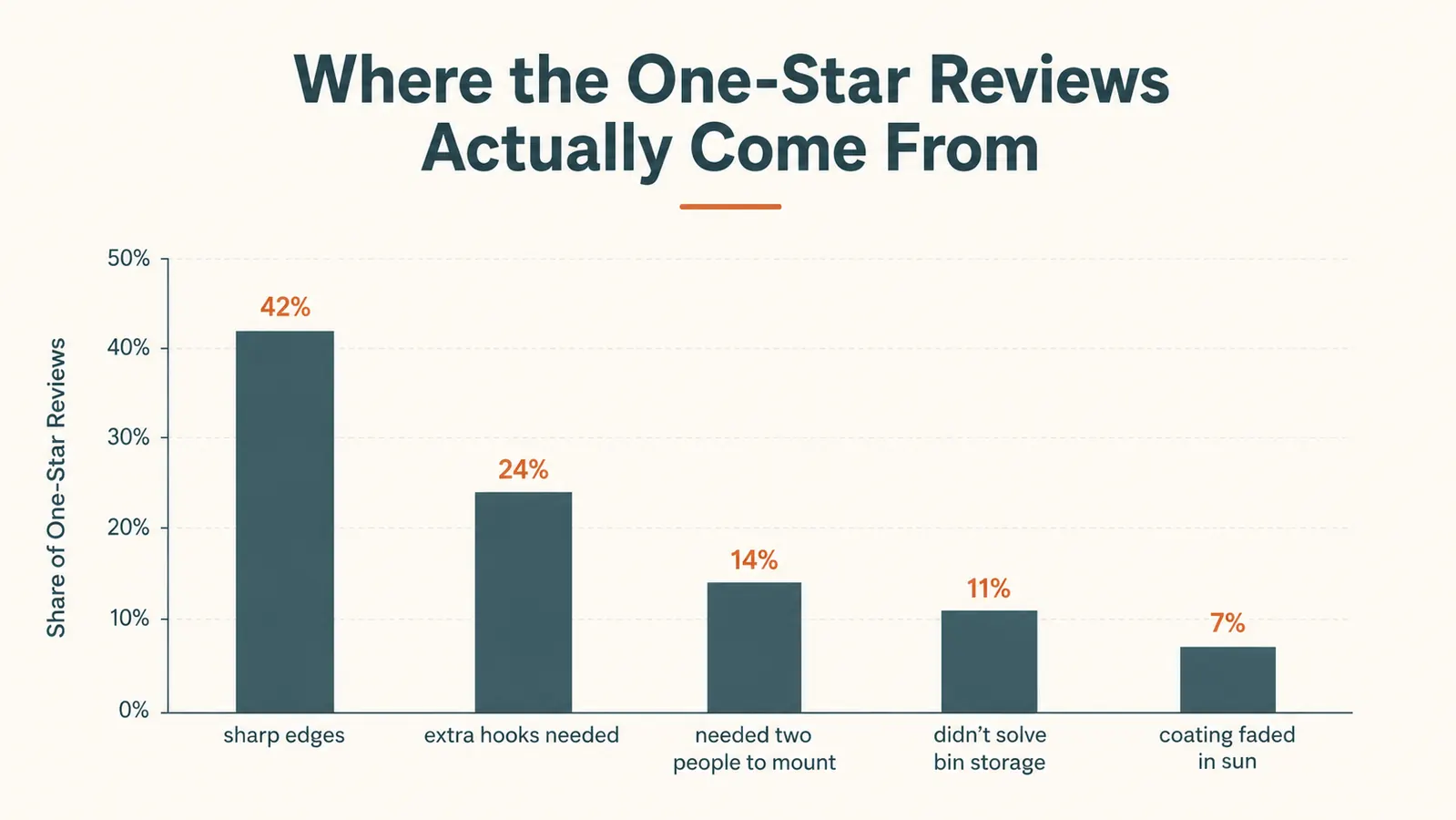
About six weeks into owning mine, I reached past a loaded hook for a hacksaw and caught my knuckle on the Wall Control panel's outer border, the cut edge of the stamped steel where the two panels meet. It wasn't a deep cut, just enough to need a bandage and a moment of genuine surprise, since nothing in the listing or the instructions mentioned that the border edges are noticeably sharper than the slotted field in the middle of the Wall Control panel. Once I knew to watch for it, I stopped catching myself on it, but that first six weeks I hadn't been looking for a hazard, because nothing told me to.
That matters more if kids or pets share the garage. Our dog Roscoe brushed against the bottom edge once chasing a tennis ball and yelped more from surprise than injury, but it was enough that I added a strip of foam edge trim along the lower border afterward, an extra purchase that runs a few dollars and isn't mentioned anywhere in the product listing. Petra's garage sees her two young nephews on weekends, and after hearing about my knuckle she added the same trim before either of them ever reached for a tool on her wall. If grandkids or young children have access to your garage unsupervised, budget for that trim before the panel goes up, not after someone gets scraped reaching for a rake.
The Real Cost Once You Add What's Missing
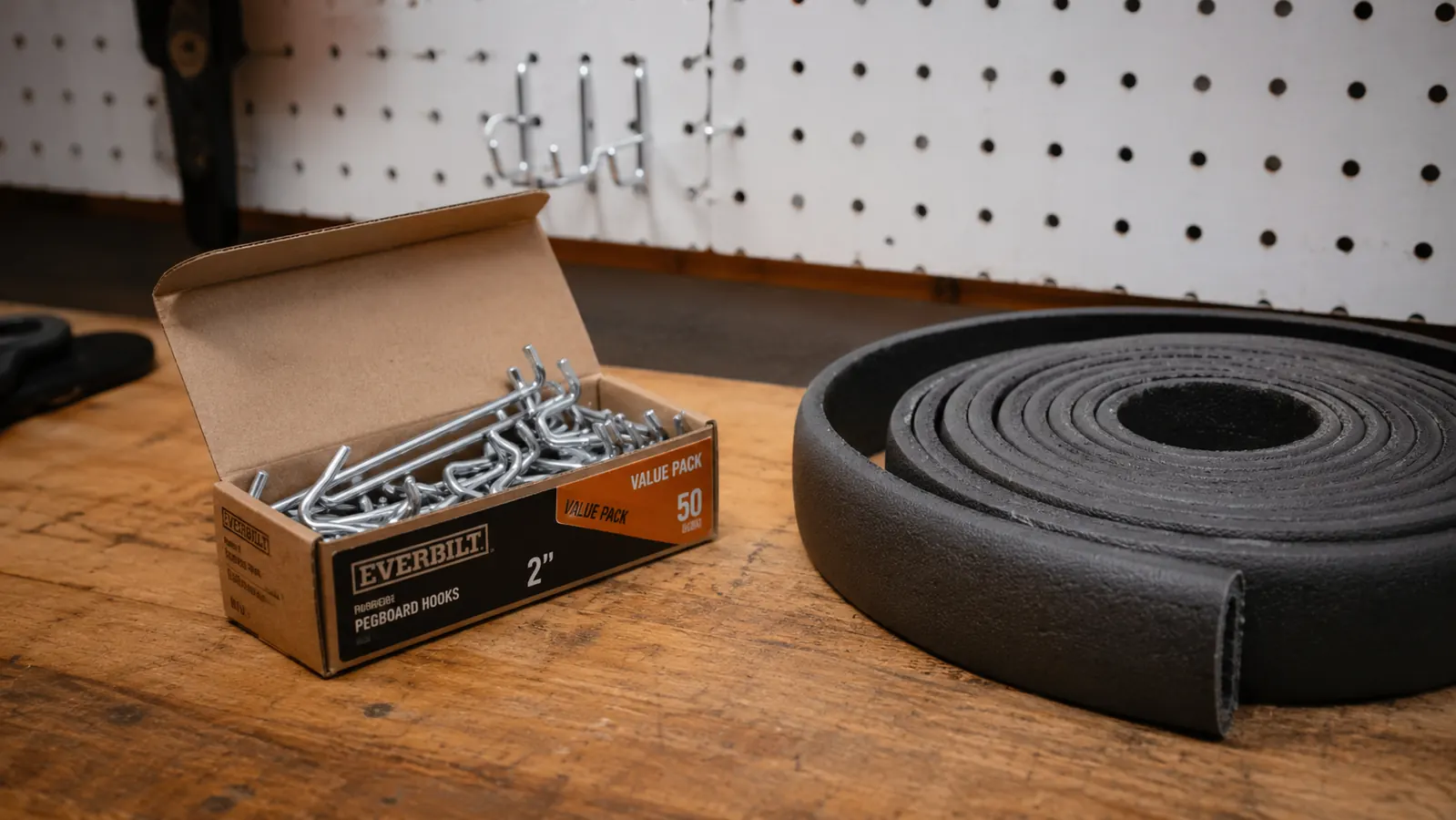
The panel kit itself runs a little over a hundred dollars, which looks reasonable next to a full slatwall system. What the sticker price doesn't include is everything you'll likely buy in the first month after. I added a second hook multipack for oddly shaped items, roughly eighteen dollars, a four-foot level since none is included in the box, about fifteen dollars, and the foam edge trim mentioned above. By the time my wall felt finished, I'd spent closer to a hundred and sixty dollars total, not the sticker figure I'd budgeted from the listing page.
Odette's version of this cost creep was worse. Because her lease didn't allow drilling into studs without approval, she had to special-order heavy-duty removable wall anchors rated for the panel's weight instead of using the screws in the box, adding significant cost and a two-week wait for the right hardware to arrive. When she eventually moves out, she'll also need wall repair compound to patch the anchor holes, a cost that never crosses your mind while you're adding the panel kit to your cart at the original price. None of these add-ons are the manufacturer's fault exactly, but none of them show up anywhere in the listing either, and together they change the real math on whether this is actually the budget option it first appears to be.
What It Won't Fix: Bins, Boxes, and Bulk
Petra's garage is the clearest example of a mismatch I see constantly. She bought the full 4-foot kit expecting it to organize the whole garage, but her actual clutter problem was mostly bins, six plastic totes of holiday decorations, a case of motor oil, and a spare set of car mats, none of which a pegboard wall can hold. The panel handled her hand tools beautifully. It did nothing for the totes still stacked in the corner, and she ended up buying a small wire shelving unit alongside the pegboard just to finish the job she thought one product would handle alone.
This is worth saying plainly before you order: pegboard organizes things you can hang on a hook. It does not organize things that come in a box, a bin, or a bag. If your garage clutter is mostly bulky items rather than a scattered pile of hand tools, this kit is going to solve maybe half your actual problem, and you should plan and budget for shelving or bin storage from the start rather than discovering the gap after the panel is already mounted and you're standing there wondering where the totes are supposed to go.
Two People, Not One, for the Install
Each panel weighs more than it looks like it should from the product photos, and the box itself is long and awkward to carry through a standard garage door opening without bumping a car fender or a parked bike along the way. I mounted mine with Graham holding the second panel level while I drove the mounting screws, and I genuinely don't think I could have done it cleanly alone. Petra tried to install hers solo on a Saturday afternoon and ended up waiting until her neighbor was free the next weekend, because holding a 4-foot steel panel flush against a wall while also driving screws into studs is a three-hand job with only two hands available.
If you're planning a solo install, at minimum use a temporary ledger board or a couple of screws driven partway into the studs to rest the panel on while you square it up, a trick a hardware store employee mentioned to Odette after her first attempt left a visible gap along one edge. It's not in the instructions, but it should be, because trying to hold, level, and fasten a full panel by yourself is where most of the frustration in this install actually comes from, far more than anything to do with the mounting hardware itself.
The Noise and the Sun
Nobody mentions that metal hooks against a metal panel make noise, a light clanging and rattling every time the garage door opens or closes and sends a small vibration through the wall. A wrench sitting snug in its hook doesn't move. A tape measure or a small level, lighter items with less contact against the hook, will swing and tap the panel for a second or two after the door slams. It's not loud enough to bother anyone, but it's a small daily sound the tan hardboard version I used to own never made, since wood doesn't ring the way steel does, and it caught me off guard the first week.
The other thing I didn't expect was sun fade. My garage door stays open most afternoons, and the section of panel closest to the opening has visibly dulled compared to the shaded half after roughly ten months, a faint chalkiness in the black powder coat where direct sun hits it daily. It hasn't affected how anything hangs or holds, and it's the kind of thing you'd only notice standing right next to it, but if your garage door stays open for hours most days, expect the same uneven fading over time, especially on a south-facing bay.
What I Liked
- 22-gauge steel panels genuinely feel and perform differently from a hardware store hardboard version
- Standard slotted grid accepts generic hooks, not just the included set, once you buy a second pack
- Held up structurally across all three installs with no sagging or warping
- Rearranging the layout takes minutes and leaves no new holes
- Resists moisture and humidity swings far better than pressboard alternatives
Where It Falls Short
- Cut edges along the panel border are sharper than the listing suggests; budget for foam edge trim if kids or pets share the space
- Real total cost runs higher once you add hooks, a level, and edge trim not included in the box
- Realistically a two-person install; going solo is possible but frustrating
- Solves visible hangable-tool storage only, does nothing for bins, boxes, or bulky items
- Metal hooks rattle against the panel when the garage door slams, and sun exposure can visibly dull the coating over time
The panel's edges will nick you before the tools you're hanging ever do. Nobody puts that in the listing photos, and it's the first thing I'd tell a friend before they order one.
Who This Is For
This kit is genuinely worth it if you own your home, have a real open stretch of studded wall, and your garage clutter is mostly loose hand tools, cords, and garden gear rather than bulky boxed items. It's a strong fit if you're willing to spend a little past the sticker price on a level, a second hook pack, and some edge trim to round out the setup properly, because those small additions are what actually make the finished wall safe and functional day to day, not just photogenic in a listing photo.
It's also a good match if more than one person shares the garage and needs to find tools without asking, or if you've already tried a cheap tan pegboard and watched it sag or warp within a year or two. The upgrade to steel really is the difference, as long as you go in with a realistic budget, a second set of hands for install day, and a plan for the sharp edges before anyone reaches for a tool near them.
Who Should Skip It
Skip it if you're renting and can't get clear approval to drill into studs, the way Odette wishes she'd checked first. The removable-anchor workaround exists, but it adds cost, delay, and eventual patch-up work that a homeowner never has to think about. Skip it too if your garage is genuinely small, under about ten feet of usable wall, since the full 4-foot kit may be more panel than your space can put to good use, the way it turned out for Petra before she considered a shorter layout instead.
And skip it, at least as your only purchase, if your real clutter problem is bins, totes, and boxed items rather than loose hand tools. You'll still need shelving or a bin system alongside it, and buying the pegboard first without planning for that second purchase is the single most common regret I hear from people who order this kit expecting it to solve everything at once. If you want the fuller side-by-side on cost and capacity, we compared this exact kit against a slatwall setup in pegboard vs. slatwall panels for a garage wall, and if you want to see how one household's full season with this panel actually played out day to day, that's covered in our long-term use review.
Now You Know the Real Costs, Here's Where to Check the Current One
Steel that doesn't sag, an edge worth guarding, and a total cost a little past the sticker. If that tradeoff still sounds worth it for your garage, see today's price and current availability on Amazon.
Amazon Check Today's Price on Amazon →