
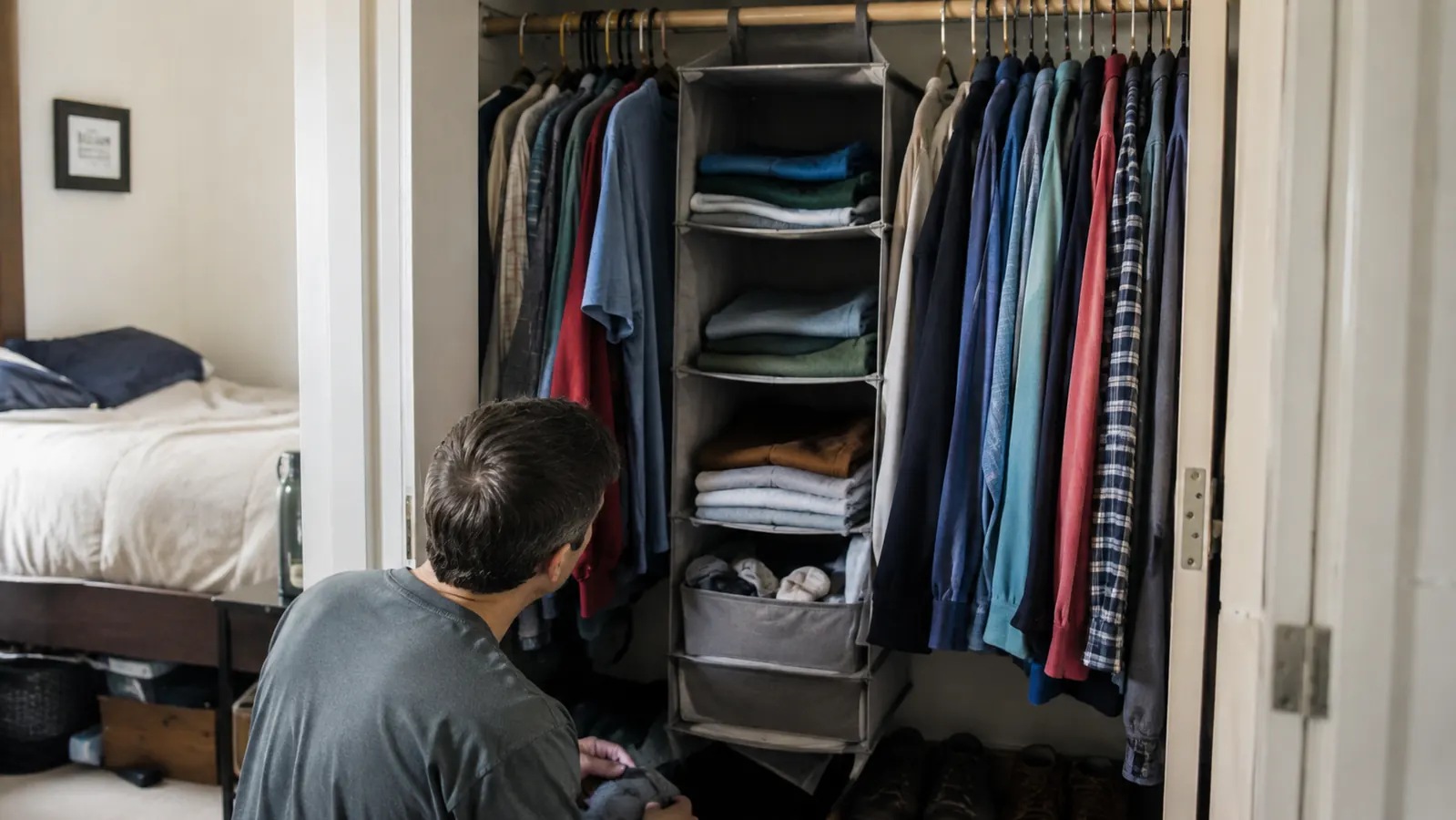
I've installed a Simple Houseware 5 Shelf Hanging Closet Organizer in three different closets over the past fourteen months: my own linen closet, a client's cramped duplex bedroom closet, and a one-rod studio apartment for a client named Priya who had exactly one closet for two adults' worth of clothes. Most reviews of this thing read like a checklist of everything it does right. Almost none of them tell you what actually goes sideways once it's been up for a few months, which is the part that matters when you're deciding whether to spend the money.
This isn't a takedown. I still recommend this Simple Houseware organizer to clients more often than almost any other closet product I own, because it solves a specific problem cheaply and does that job well. But there's a real weight limit that gets ignored constantly, a sizing quirk that trips up more people than you'd expect, and a handful of small annoyances that only show up after week three, not on day one when everything still looks tidy. I want to walk through those honestly, closet by closet, before you order one for yours.
The Quick Verdict
A genuinely useful five-shelf hanging organizer for lightweight folded storage, as long as you respect the per-shelf weight limit and check your closet rod shape first.
Amazon Check Today's Price →Before you add this to your cart, check one number
This organizer is built for a standard round closet rod and a modest load per shelf. Confirm your rod shape and see today's price and current availability before you order.
Amazon Check Today's Price on Amazon →How I've Actually Used It
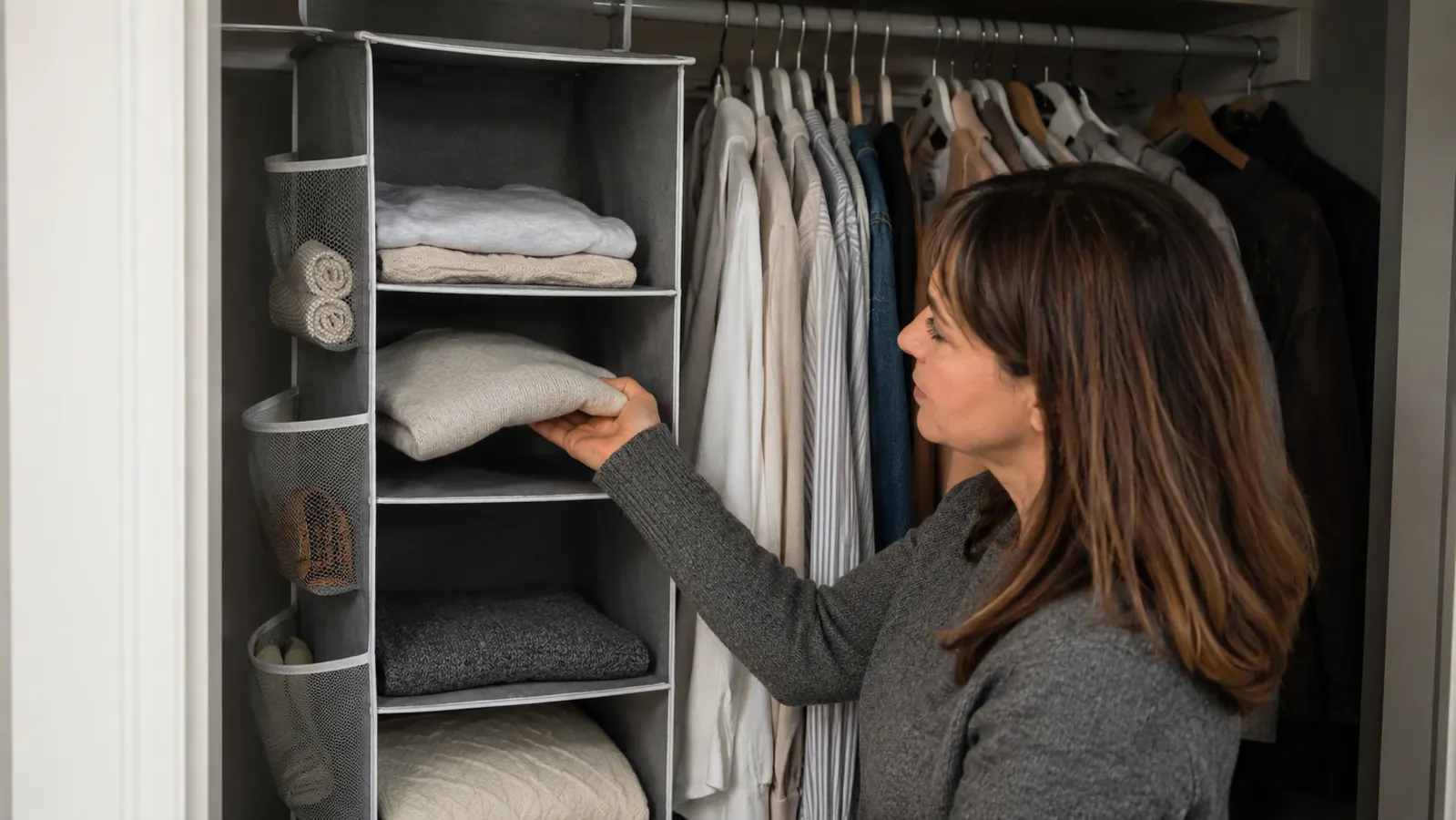
I don't use this Simple Houseware organizer the way the product photos suggest. In my own linen closet, it holds folded towels on the top three shelves and a rotating stack of extra bedding on the bottom two, because that closet already has a built-in shelf and rod for hanging clothes. In Priya's studio apartment, it does the opposite job: it hangs from the one rod she has and holds folded sweaters, gym clothes, and a shoebox of camping gear, so the rod underneath stays free for coats and dresses. Same product, two completely different jobs, and that flexibility is genuinely the best thing about it.
My client in the duplex, the Delgado family, has had theirs the longest, almost fourteen months in a kids' shared closet holding folded pajamas, board games, and a bin of art supplies. That closet gets opened and slammed shut by two grade-schoolers probably twenty times a day. If anything was going to reveal a design weakness, it would be that closet, and it did, which I'll get to below.
I mention all three because a lot of reviews get written after two or three weeks of use, right when everything still looks like the listing photo. Fourteen months of two kids yanking shelves open every morning tells you something different than fourteen days of careful, gentle loading. It's the difference between reading a recipe and actually eating the meal a month later, once the leftovers have had time to tell on it.
The Sizing Surprise Nobody Mentions
The single most common mistake I see, both in my own work and scattered through the Amazon Q&A section, is buying this without checking the closet rod's shape first. This Simple Houseware organizer is built for a standard round closet rod, roughly the width of a broom handle. It doesn't clip on well to square wardrobe bars, the flat oval rods some newer closet systems use, or the thin wire shelving rods common in older rental units. Priya's studio had a standard round rod and it worked immediately. A different client with a newer townhouse had a flat oval closet rod, and the straps kept sliding sideways until we added a short length of round dowel as an adapter.
The other sizing surprise is depth, not width. The shelves are shallower than most people picture from the photos, closer to the depth of a folded t-shirt than a folded bath towel. Bath towels hang slightly off the edge on every unit I've used. That's fine once you know it going in and plan the shelf for smaller folded items, but it's a letdown if you were picturing it swallowing an entire towel collection.
Before you order, I'd actually get out a tape measure rather than trust your eye. Measure the rod's diameter, not just whether it looks round, and measure the vertical clearance from rod to closet floor. If you're tight on headroom, the Simple Houseware organizer's five stacked shelves can end up brushing the floor or a lower shelf, which shortens its usable life fast since the bottom shelf takes the brunt of every closet door swinging shut against it.
The Weight Limit Per Shelf Is Real, Not a Suggestion
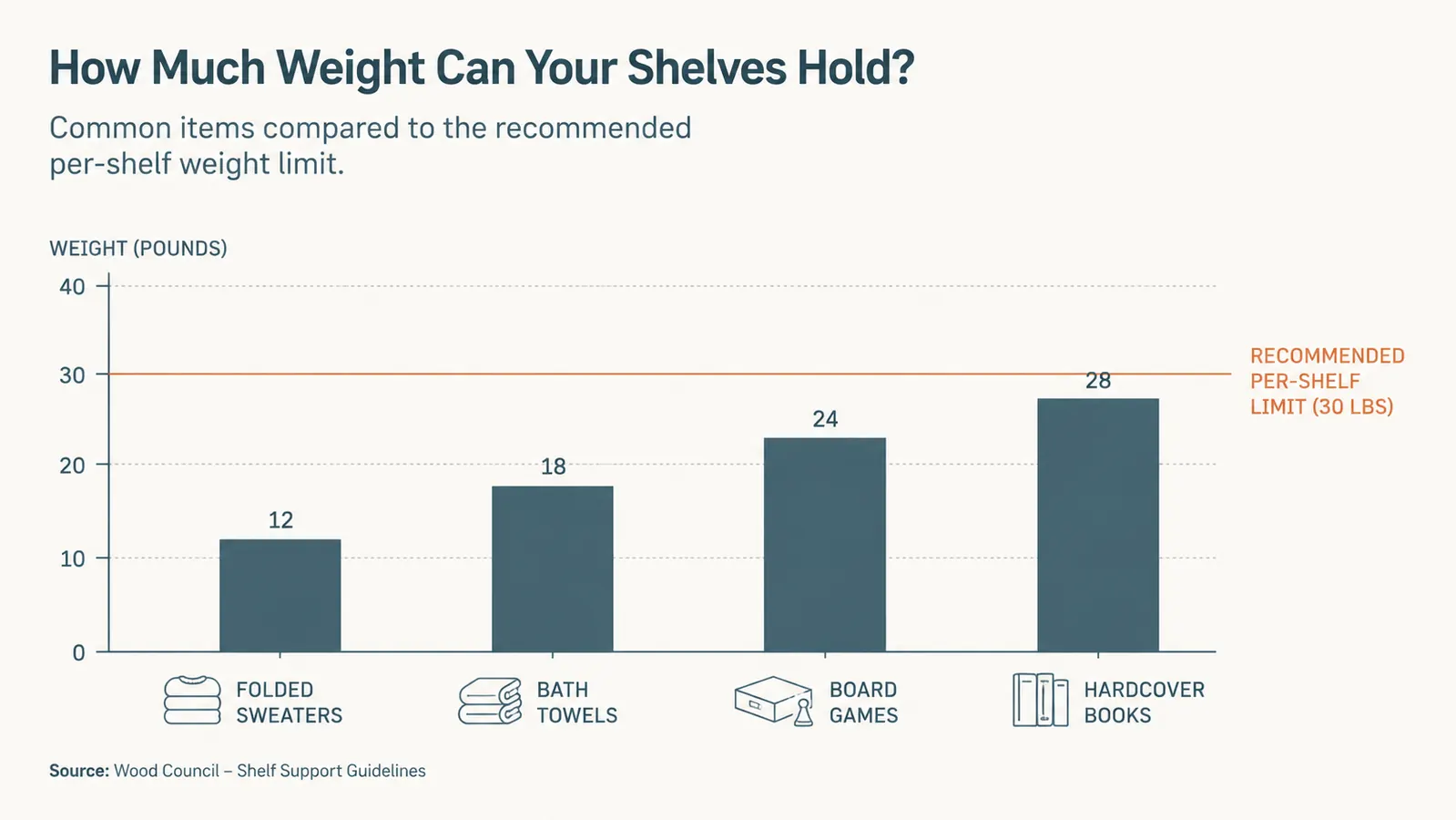
Each shelf is rated for a modest weight, and I've watched what happens when that number gets ignored. In the Delgado closet, the middle shelf sagged visibly within the first month because it was loaded with a stack of hardcover picture books and a wooden puzzle box, easily double what a single shelf is meant to carry. The canvas didn't tear, but it bowed enough that items started sliding toward the center and eventually toward the floor.
Once we redistributed the weight, books and puzzles moved to a floor bin, folded clothes and lighter craft supplies onto the shelves, the sagging stopped getting worse, but it never fully bounced back flat. If your household wants to stash board games, hardcover books, or a stack of binders on these shelves, plan on the bottom shelf only, and even then, keep it lighter than you'd think.
To put real numbers on it, a folded stack of everyday sweaters usually runs two to three pounds, a stack of bath towels closer to four or five, and that's well within what a single shelf is built to carry. Board games and hardcover books are where the math falls apart fast. A single hardcover picture book can run close to a pound on its own, and a stack of six or eight, plus a boxed puzzle, adds up to double or triple a shelf's rated capacity before anyone notices. Weigh a full load in your hand before it goes on the shelf if you're unsure, it takes ten seconds and saves you the sag.
This matters more than most listings let on because the shelves look sturdier than they are. The metal frame at the top is solid. The individual shelf platforms are canvas-backed and flexible by design, which is what lets the whole thing collapse flat for storage, but that same flexibility is the tradeoff for a lighter weight capacity than it appears to have.
What Actually Wears Out After Months of Real Use
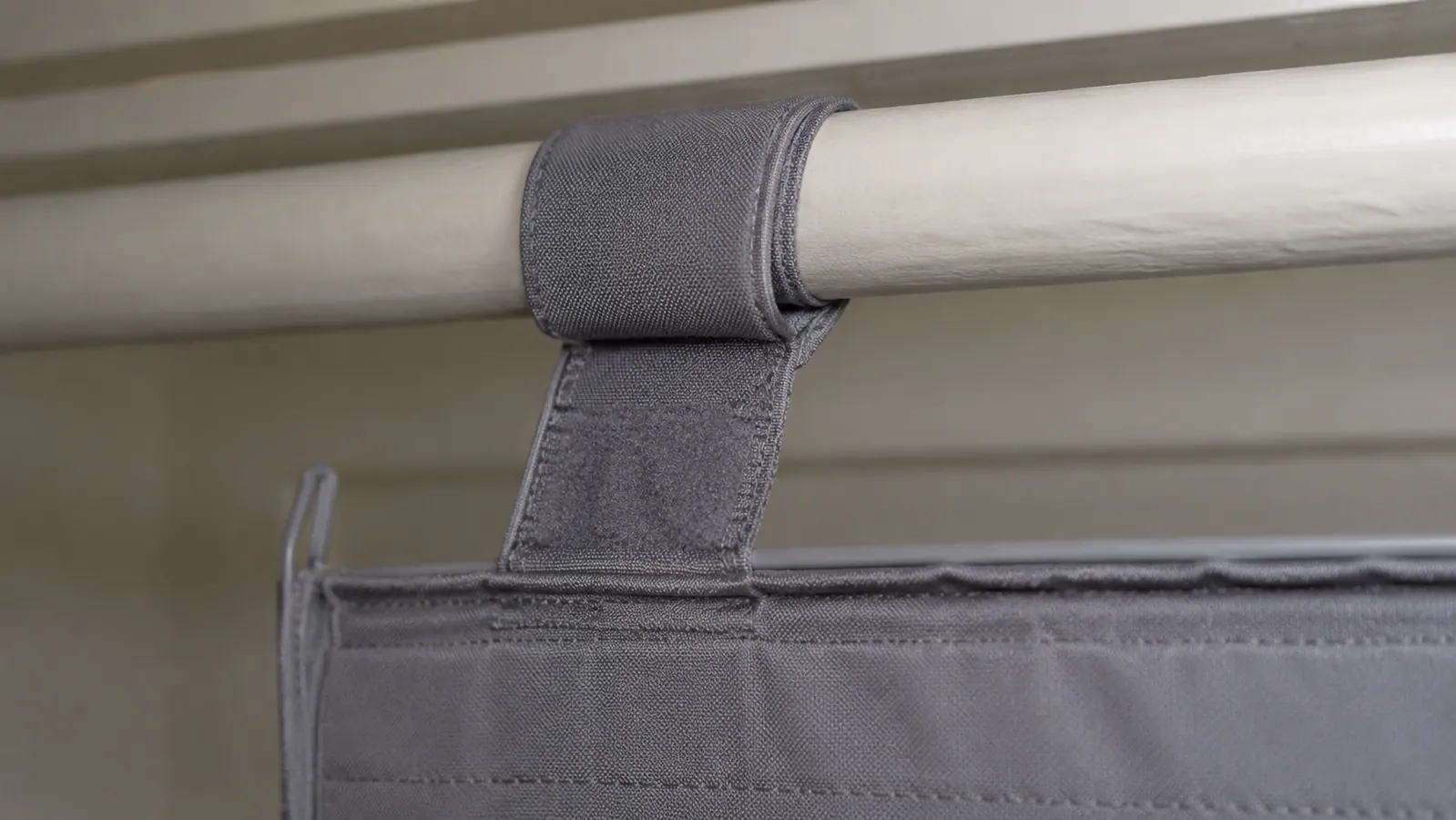
The hanging strap at the top uses a hook-and-loop closure, and on the Delgado unit, after more than a year of two kids opening that closet constantly, the strap has loosened enough that the whole organizer now sits about an inch lower than when we first hung it. It's a five-minute fix, just re-tighten the strap, but it's not a hang-it-once-and-forget-it product the way the box implies. Expect to check and retighten it every few months in a high-traffic closet.
The shelf dividers, the vertical fabric walls between each shelf, hold their shape fine under light loads but start to lean and fold inward once a shelf is even moderately overloaded. Once a divider folds over, it stays creased, and the shelf beneath it permanently loses some of its usable height. It's a small thing, but it's the kind of small thing that box photos never show you.
The small metal hooks and connectors at each corner also show light surface wear after a year, a faint dulling where fabric rubs against metal every time a shelf gets loaded or unloaded. None of that has affected function on any of the three units I've watched. It's a cosmetic note, not a structural one, but if you're picturing this looking factory-fresh forever, it won't.
None of this has ever pushed me to return a unit, and across three households and fourteen months, I haven't needed to use a warranty or replacement on any of them. But if something does arrive damaged or a strap fails outright rather than just loosening, keep the packaging for a couple of weeks and register the purchase. A minor manufacturing defect is a different problem than normal wear from real use, and it is worth sorting out which one you are actually dealing with before you assume the product itself is at fault.
Hanging It Takes Longer Than the Box Suggests
Technically there's no assembly, it's a hang-and-go product, which is most of the appeal. But getting it level and evenly hung takes more fiddling than the packaging implies. Both straps have to be tightened to matching lengths or the whole unit hangs crooked, and on a standard round rod that's easy, maybe five minutes. On an oval or flat rod, or a rod mounted unusually close to the closet ceiling, it can take twenty minutes of adjusting before it sits straight and doesn't tip forward when you load the top shelf.
I'd also mention that loading the top shelf first, before the others, makes the whole thing harder to keep balanced while you're still adjusting the straps. Load the bottom two shelves first for stability, then work upward. Nobody mentions that in the instructions, and it would have saved me some frustration on my first install.
What the Star Rating Doesn't Show You
This organizer sits above 4.5 stars across tens of thousands of reviews, and that number is legitimate, most buyers are genuinely happy with it. But when you sort the reviews by lowest-rated instead of most helpful, a pattern shows up fast: nearly every one-star or two-star complaint traces back to one of two things, a rod that wasn't round, or a shelf loaded far past what it was built for. Those aren't manufacturing defects. They're mismatches between expectation and the product's actual limits, and the listing photos do very little to head that off before you buy.
I also think star ratings on a product like this skew toward week-one enthusiasm. Most reviewers post within days of unboxing, when the shelves are still perfectly square and nothing has had time to sag or loosen. A five-star review from day four and a four-star review from month five are answering two different questions, even though the listing displays them side by side with equal weight. That's not a knock on the product, it's just worth keeping in mind while you're reading through the review list trying to decide.
None of that changes my overall take. A rating built on that many real purchases still means most people get real, lasting use out of it, which lines up with what I've seen across three households. It just means the honest picture is slightly less perfect than the star count alone suggests, and closing that gap is exactly what this review is trying to do.
What I Liked
- Turns one closet rod into hanging plus folded storage with no tools required
- Collapses flat in seconds if you need to move it or pack it away
- Fits most standard round closet rods without any adapter
- Affordable enough to buy two or three for different closets
- Canvas shelves wipe clean or spot-wash easily
Where It Falls Short
- Per-shelf weight limit is lower than it looks, overloading causes visible, lasting sag
- Struggles on flat oval or square wardrobe rods without a workaround
- Shelves are shallower than a folded bath towel
- Hanging strap loosens over months of heavy closet-door traffic and needs retightening
- Shelf dividers crease permanently once a shelf is overloaded
The shelves look sturdier than they are. That's not really a flaw, it's a tradeoff for something that folds flat and costs less than a nice dinner out, but it's a tradeoff you should know about before you load it with hardcover books.
Who This Is For
This organizer earns its spot in a closet where the main job is lightweight folded storage: t-shirts, gym clothes, kids' pajamas, craft supplies, extra linens, or shoes. It's especially good in a one-rod apartment or a shared kids' closet where you need to double up storage without installing anything permanent. If you rent and can't drill into a closet wall, this is one of the few organizers that adds real capacity with zero holes to patch later, and it's cheap enough to try in more than one closet before you commit to something bigger.
Who Should Skip It
Skip it if your closet rod is flat, oval, or square instead of round, unless you're willing to add an adapter. Skip it if you were planning to store board games, stacked hardcover books, heavy blankets, or anything dense on more than the bottom shelf, you'll be disappointed within weeks. And skip it if you want a truly rigid shelf that never flexes when you set something down, since some flex under load is baked into the design, not a defect in your specific unit. For that, you're better off with mounted closet shelf dividers, which we compare directly in our side-by-side breakdown of this organizer against built-in shelf dividers. If you want the slower-burn story of what fourteen months with this exact organizer looked like in one household from day one, our long-term use review covers that ground in more depth.
Know the tradeoffs, still worth it for the right closet
If you keep the load light and check your rod shape first, this remains one of the fastest, cheapest ways to add real storage to a single-rod closet. See current availability and today's price on Amazon.
Amazon Check Today's Price on Amazon →