

For three years, our front hall was a landing strip for whatever the day dropped. Backpacks slid off shoulders and stayed exactly where they fell. Rain boots tipped over into little puddles on the hardwood. My husband Mark's laptop bag lived on the second stair step because nowhere else made sense. I tried a twelve-dollar shoe tray. I tried a row of adhesive hooks that peeled off the drywall by week two. What actually stuck, a year in, is the HOMCOM Hall Tree with Bench and Shoe Storage, a 3-in-1 coat rack, bench, and shoe cubby unit we installed last October and have used every single day since.
This isn't a first-week impression. I'm writing this after twelve months with two kids, Eli who's ten and Nora who's seven, one very muddy dog named Biscuit, and a rotating cast of soccer cleats, dance bags, and grocery totes passing through that same 45 inches of wall space. Here's what actually held up, what didn't, and who this bench is worth the current price for.
The Quick Verdict
A genuinely useful all-in-one entryway station that earns its footprint daily, as long as you have the wall space and don't mind a real assembly afternoon.
Amazon Check Today's Price →Tired of Tripping Over the Same Pile of Shoes?
See today's price and current availability for the HOMCOM Hall Tree before you spend another weekend rearranging hooks that don't work.
Amazon Check Today's Price on Amazon →How I've Used It
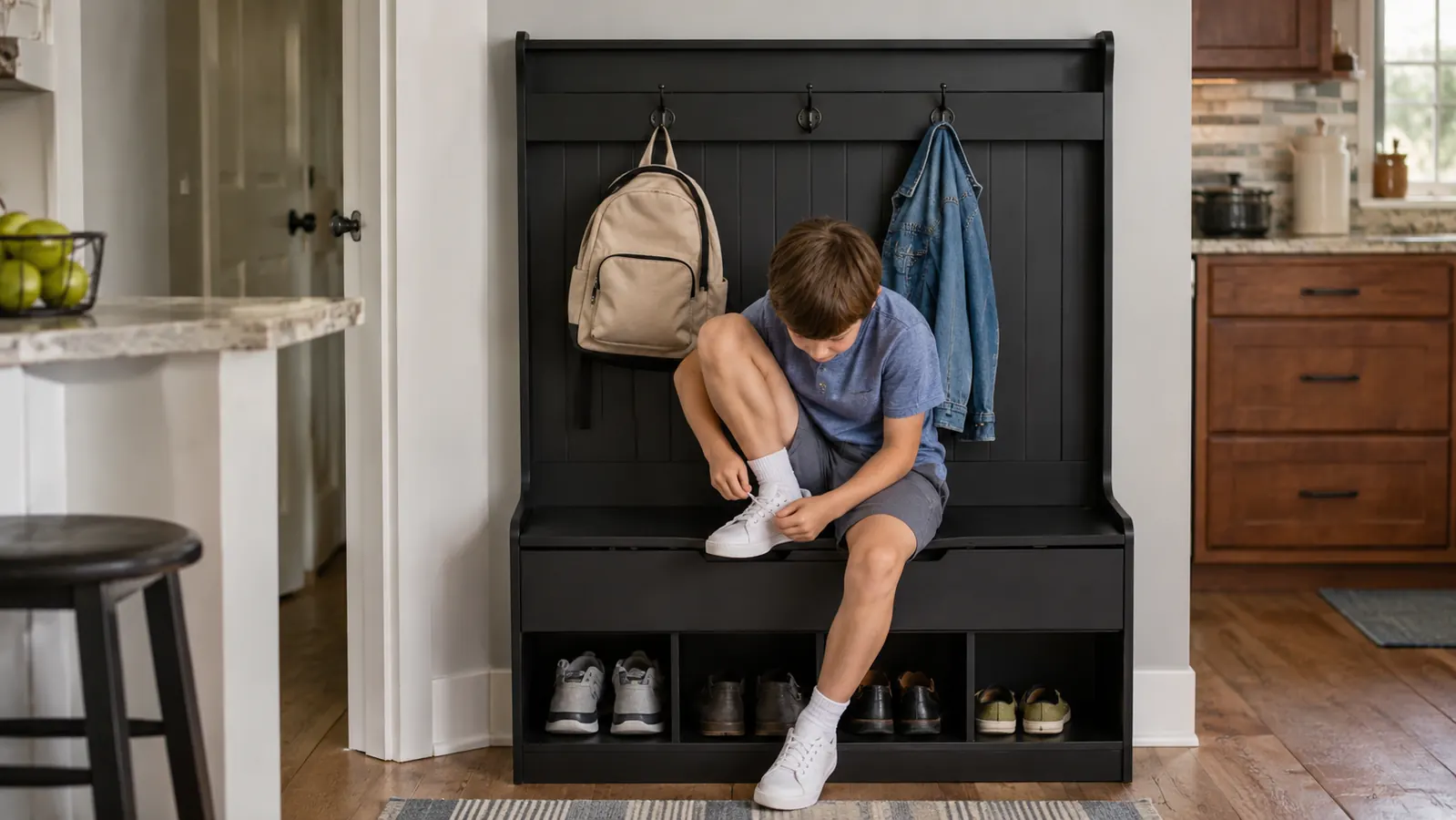
We set the HOMCOM hall tree against the wall just inside our front door, in the spot where a narrow console table used to live and constantly get buried under mail and mittens. The HOMCOM bench seat is wide enough that Eli can actually sit down to pull off his cleats instead of hopping on one foot in the doorway, which was the whole point of buying it. Underneath, three open shoe cubbies hold six pairs without anything toppling over, and the coat rack section above has five hooks plus a flat shelf on top for hats, gloves, and Biscuit's leash.
Assembly took Mark and me about ninety minutes on a Saturday morning, longer than the box implied but not unreasonable for a piece this size. The hardware was labeled and the panels came pre-drilled, so it wasn't a guessing game, just slow going with two people and a screwdriver. I'd budget a real afternoon rather than trying to squeeze it in before nap time.
Within the first month it became the drop point for everything. Backpacks went on the hooks, shoes went in the cubbies, and for a stretch when Nora still needed one, the diaper bag lived tucked under the HOMCOM bench seat. It replaced three separate half-measures we'd tried before it, and for the first time in years the hallway floor actually stayed visible on a Tuesday afternoon.
The top shelf turned out to be more useful than I expected going in. I keep a shallow wicker tray up there for mail and a small dish for keys, and because it sits above eye level for Nora, it's also become the one spot in the house where a set of car keys reliably does not vanish into a couch cushion. Small thing, but after years of hunting for keys before school drop-off, it mattered.
The Build: What a Year of Boot Traffic Does to an Engineered Wood Frame
The frame is a black engineered wood, an MDF-style panel with a matte laminate finish, not solid wood, and I want to be upfront about that because the listing photos can make it look heavier and more substantial than it is in person. The coat hooks and the frame brackets are metal, and those are the parts doing the real work of holding weight day after day.
A year of boots, backpacks, and one kid who treats every hook like a chin-up bar has left a few faint scuff marks on the top shelf edge and one small chip near a corner where a scooter got leaned against it more than once. Nothing structural. The panels have not warped, swelled, or delaminated despite sitting a few feet from a front door that lets in real Midwest humidity swings between seasons.
The hardware has held up better than I expected. None of the hooks have loosened, the HOMCOM bench seat doesn't creak under an adult sitting down to change shoes, and the cubby dividers are still square. I did go back through with a screwdriver around month six and snug up a couple of screws that had worked slightly loose, which took about five minutes and is honestly normal maintenance for any assembled furniture that gets sat on daily.
Weight and Wear: What I Watched For
Because the bench seat gets sat on by grown adults, not just kids, I paid close attention to whether it would start to sag or bow in the middle the way cheaper assembled furniture sometimes does. A year of Mark, at over two hundred pounds, sitting down every morning to lace up work boots hasn't produced any visible dip in the seat panel. I check it periodically because that's the kind of failure that creeps up slowly, and so far it's held its shape.
The coat hooks were the other thing I kept an eye on, since ours regularly carry a full winter coat plus a backpack stacked on the same hook, which is more weight than a single hook is technically meant for. None have bent or pulled loose from the rail. If I were designing my own use case from scratch, I'd still spread bulkier items across two hooks instead of stacking, just to be kind to the hardware over the long run.
A Full Year, Season by Season
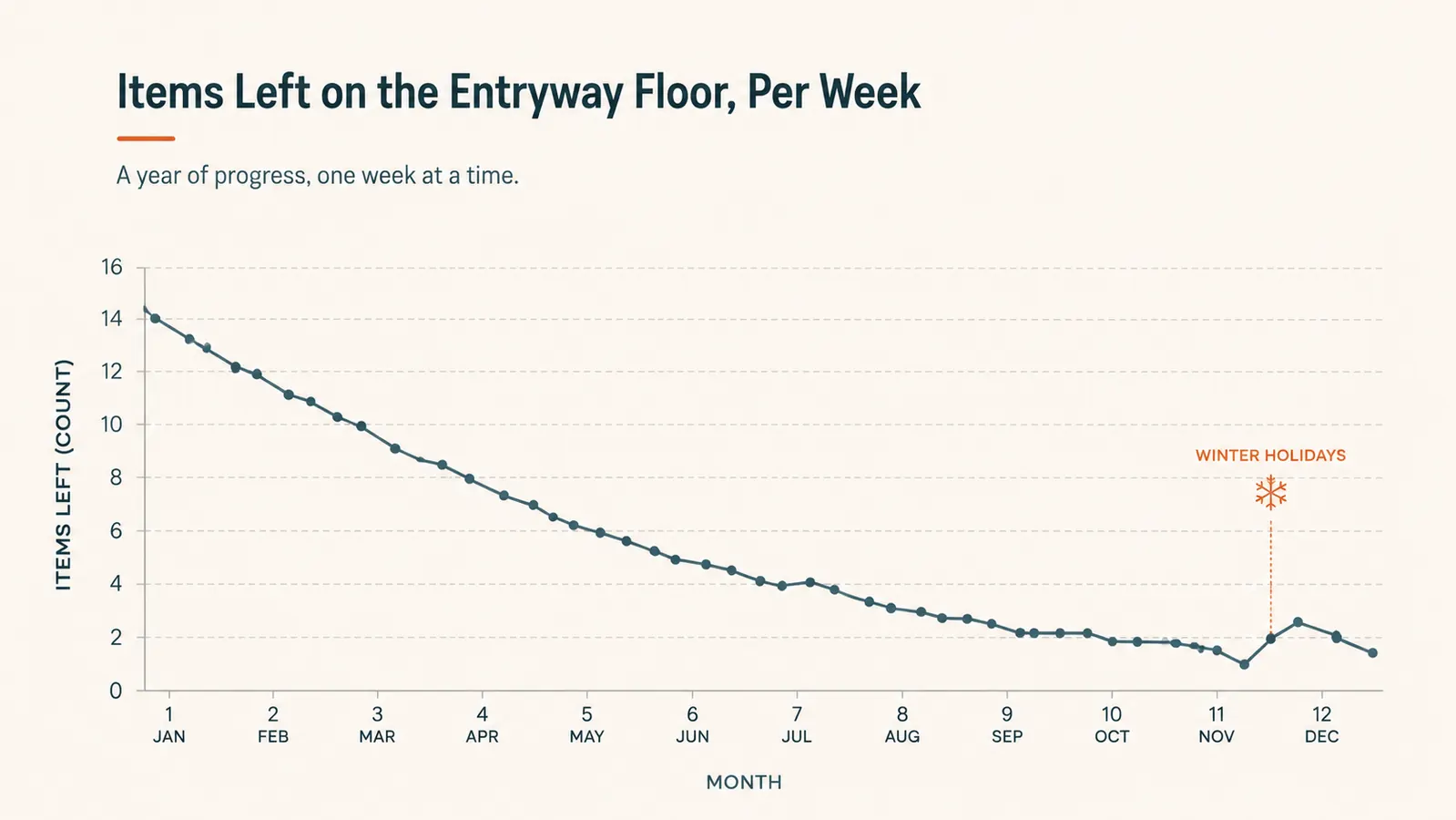
Fall was the easy season. Light jackets, dry sneakers, and the occasional soccer cleat. This is the version of the bench you see in the product photos, tidy and lightly used, and it's not a fair test of anything. The real test started in November when the weather turned.
Winter is where I actually learned what this piece could handle. Snow boots dripping onto the cubby floor, heavy winter coats stacked two deep on hooks meant for one, and Biscuit tracking in slush that pooled a little on the open shoe shelf. The cubbies aren't sealed or lined, so I started keeping an old towel folded in the bottom one for the worst days, which solved the puddle problem completely and took thirty seconds to set up.
The holidays were the single hardest stretch it's been through. With extended family in and out over a two-week span, the five hooks filled up fast and we ended up draping a couple of extra coats over the bench arm rather than the wall behind the door the way we used to. It wasn't a failure exactly, more proof that this bench is sized for a normal household, not a holiday party, which is a fair limitation to know about ahead of time.
Spring brought rain gear and the return of muddy paws, and summer brought the opposite problem: too much stuff. Between two kids' sports schedules, the bench and cubbies filled up fast with cleats, sandals, and a rotating dance bag. That's when the footprint limits became obvious. Five hooks and three cubbies are plenty for a typical Tuesday, but on a Saturday with both kids' gear bags piled up, we're doubling up on hooks and living with a slightly more crowded entryway than the catalog photo suggests. It's still better than the floor pile we had before, just not infinite storage.

Where It Falls Short
The footprint is the first real tradeoff. This unit needs roughly 45 inches of wall space and about 20 inches of depth once you account for someone actually sitting on the bench, which is more than a lot of apartment entryways or narrow hallway landings have to give. Before you order it, I'd genuinely walk to your entry with a tape measure. It's a mistake to assume it'll fit because it looked compact in a photo, and I say that as someone who eyeballed it and got lucky.
The shoe cubbies are shallower than I'd like for tall winter boots. Most sneakers and kids' shoes sit fine, but adult snow boots or tall rain boots tend to lean forward and poke out a little rather than tucking flush. It's a minor annoyance, not a dealbreaker, but it's the kind of detail that only shows up after a real season of use, not a first look.
Assembly quality control was mostly fine but not flawless. One of our coat hook screws arrived slightly stripped and needed a bit of extra patience to seat properly, and the instruction diagrams for the final panel were a step harder to follow than the rest. Nothing that stopped the build, just enough friction that I wouldn't call the assembly effortless.
The matte black finish also shows dust and light scratches more readily than a wood-grain finish would. I wipe it down about once a week with a microfiber cloth, mostly along the top shelf and hook rail where hands and coat zippers make contact, and that keeps it looking presentable. If you're not someone who wipes down furniture regularly, know that a matte black surface in a high-traffic entry will show it faster than most other finishes would.
What I Considered Instead
Before landing on this hall tree, I seriously looked at a simple row of wall-mounted coat hooks, which costs a fraction of the price and takes fifteen minutes to install. I laid out the full comparison, including where hooks alone actually win, in Hall Tree Bench vs. Wall-Mounted Coat Hooks. The short version is that hooks alone solved the coat problem but did nothing for the shoe pile or the lack of a place to sit down, which for us was half the reason the entryway felt chaotic in the first place.
I also priced out a built-in mudroom cabinet system through a local carpenter, which would have looked incredible and cost close to two thousand dollars installed. For a rental-adjacent budget and a family that might move in a few years, an all-in-one bench that ships flat and bolts together in an afternoon made a lot more sense than a permanent build-out. If you want the fuller case for why a bench like this beats piecemeal fixes, I go through it in 10 Reasons an Entryway Bench Fixes a Chaotic Mudroom.
What I Liked
- Bench seat makes shoe changes actually happen instead of getting skipped
- Coat hooks and hardware have held real daily weight for a full year without loosening
- Shoe cubbies keep six-plus pairs off the floor and visible at a glance
- Assembly hardware is labeled and panels are pre-drilled
- Handles seasonal swings, from light fall jackets to bulky winter coats, without structural issues
- Top shelf doubles as a mail and keys catch-all
Where It Falls Short
- Needs about 45 inches of wall space, tight for small entryways or apartments
- Shoe cubbies are shallow for tall winter or rain boots
- Not solid wood, engineered panel construction shows minor scuffs after a year
- Assembly took closer to ninety minutes than the box suggested
- Gets crowded on high-traffic weekends or when extended family visits
- Matte black finish shows dust and scratches more than a wood-grain finish would
The real test of an entryway piece isn't day one, it's day three hundred, when nobody's trying anymore and the shoes still land in the cubby out of habit.
Who This Is For
This bench earns its keep in a household where multiple people come and go daily, kids with backpacks and sports gear, a dog that needs a leash within reach, or anyone who wants a single dedicated spot for coats and shoes instead of three scattered ones. If your entryway currently doubles as a junk catch-all and you have the wall space to give it, a year of use has convinced me this is a real fix, not a decorative one. It's also a solid pick if you've tried cheaper individual pieces before and are tired of buying a hook rack this year and a shoe rack next year.
Who Should Skip It
If your entry hallway is under 40 inches wide, or you live somewhere you can't drill into drywall to anchor a tall piece near a doorway that gets bumped, skip this one and start with wall hooks and a slim shoe rack instead. It's also not the right pick if you only need a spot for one or two people's shoes and coats. The bench's real advantage shows up with volume and traffic, and a smaller household may find it more furniture than the entryway actually needs. And if you regularly host large groups, plan on it being one part of your coat solution rather than the whole answer.
See What a Year of Real Use Looks Like Before You Buy
Check today's price on the HOMCOM Hall Tree with Bench and Shoe Storage and get the entryway drop zone that's actually still working a year in.
Amazon Check Today's Price on Amazon →