
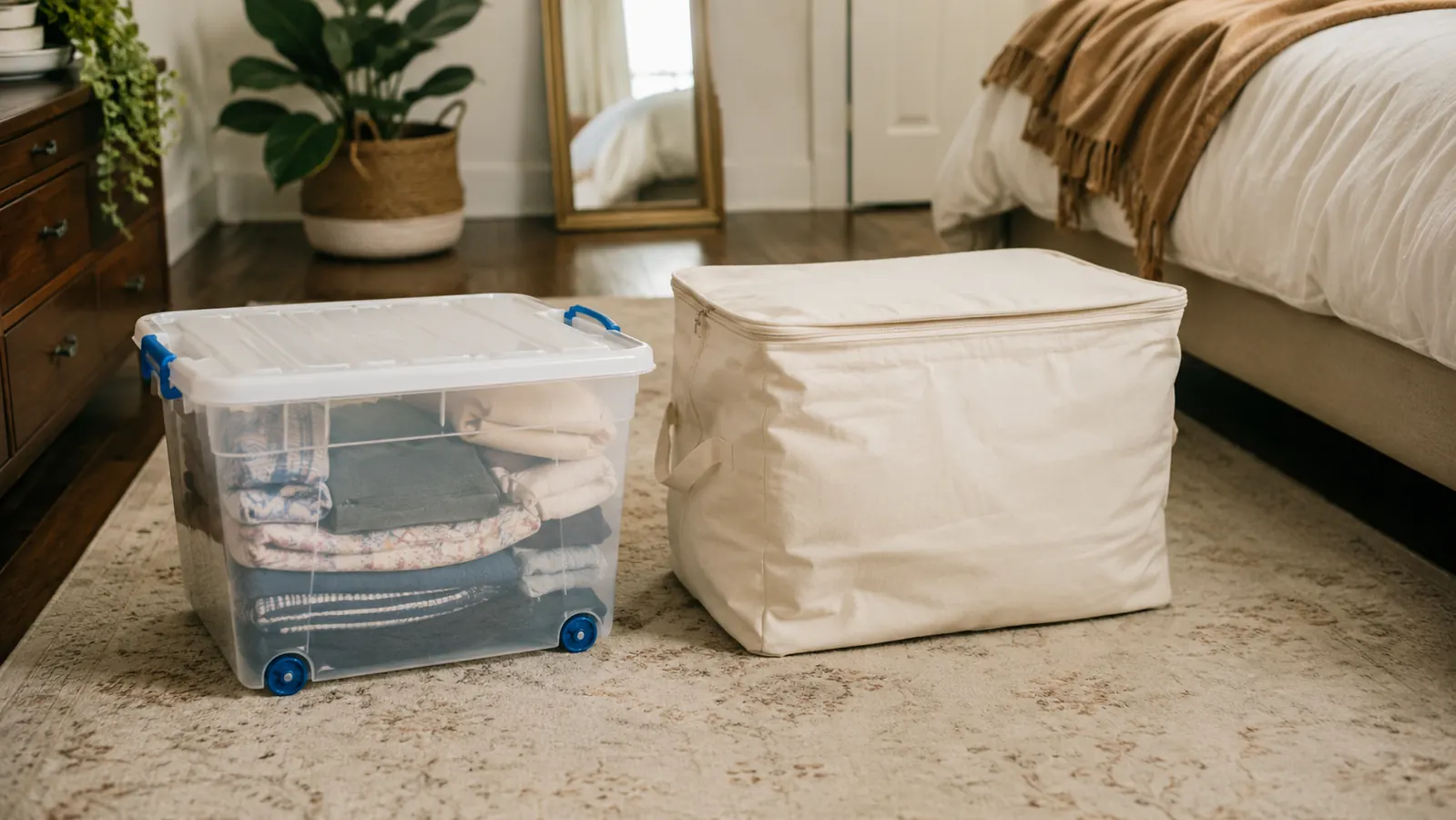
Short answer first, since I know that's why you're here: if the Sterilite bin has to survive being loaded, shoved under a bed frame, and pulled back out every few months for a couple of years, get the rigid wheeled bin. I've run a set of Sterilite 56-quart wheeled latching bins under three different beds in my own house against a stack of soft zippered storage bags I already owned, and the difference showed up faster than I expected. Soft bags aren't useless. They just lose almost every category that matters once you're storing something heavier than a couple of sweaters, and once you've watched a bag's seam split under a stack of winter blankets, you stop trusting it with anything you'd actually miss.
This isn't a brand-name-versus-brand-name fight. Soft under-bed bags are mostly interchangeable, a canvas or non-woven shell with a zipper and sometimes a vinyl window, sold under a dozen labels at big-box stores and online, and I've owned versions of at least four of them over the years. What I'm comparing is the category: rigid, wheeled, latching plastic bins on one side, and collapsible fabric bags on the other, with the Sterilite 4-pack as the specific product I tested and can point you to, since it's the one that's actually held up.
| Under-Bed Storage Bins | Soft Storage Bags | |
|---|---|---|
| Price per unit | Mid-range per bin, 4-pack available | Budget-friendly per bag, sold individually |
| Material | Rigid clear polypropylene | Woven or non-woven fabric shell with a vinyl window |
| Dust and moisture seal | Latching lid presses down on a raised lip, keeps dust out | Zipper only, gaps at the seams let dust and moths in |
| Mobility under the bed | Built-in wheels, rolls out one-handed | No wheels, has to be dragged or carried out flat |
| Weight capacity | Holds folded blankets and winter coats without sagging | Bottom seam stretches and can split under heavy loads |
| Pest resistance | Solid plastic walls, nothing to chew through | Fabric shell, vulnerable to mice and moths over time |
| Storage footprint when empty | Doesn't collapse, still takes up bin-sized floor space | Folds flat, stores in a drawer or closet shelf |
| Bed frame clearance needed | About 6 inches to slide the bin in | Fits under frames with as little as 4 inches |
| Contents visibility | Clear sides, contents visible at a glance | Vinyl window yellows and fogs within a year or two |
How I Tested Both
I split my off-season storage across both systems on purpose. Winter coats, snow boots, and a set of guest bedding went into two of the Sterilite bins under our queen bed. A rotation of my daughter's outgrown soccer gear, spare pillows, and holiday wrapping paper went into three soft zippered bags under the guest room's lower-clearance daybed, because the daybed only leaves about five inches of clearance and the bins wouldn't slide under it at all. That split turned out to be a useful accident, because it showed me exactly where each style earns its keep, and it meant I was never comparing an easy job for one system against a hard job for the other.
Every three to four months I pulled everything out, checked the contents, and vacuumed underneath. I wasn't gentle about it. The bins got kicked, stacked two-high in the closet during a mattress swap, and loaded past what I'd call a reasonable weight more than once, including one stretch where I crammed an extra fleece throw and two pairs of hiking boots in on top of the folded coats. The soft bags got the same treatment: dragged, restuffed, and left alone through a humid Ohio summer. Neither one got babied, which is the only fair way to compare them.
Where the Wheeled Bin Wins
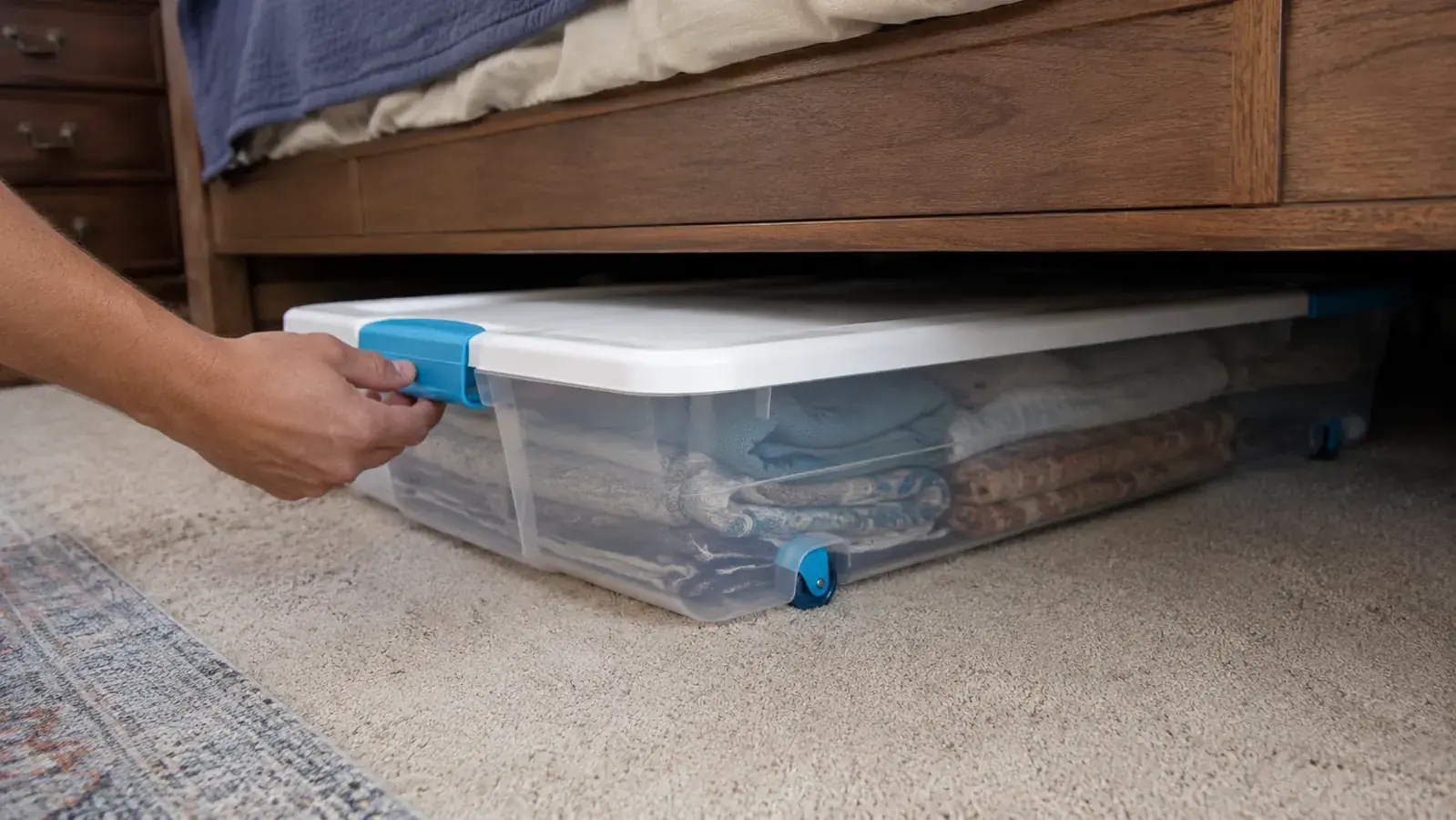
The latching lid is the whole story. After ten months, the bins under our bed had zero visible dust inside, even though the room gets vacuumed maybe once a week and the underside of a bed frame is exactly the kind of place dust settles and stays. The lid's raised lip and the four side latches keep it closed tight enough that I've never once opened a bin to find a layer of grime on top of the folded blankets. That matters more than it sounds like it should when you're storing anything you plan to actually wear again, guest sheets, a winter coat, a favorite quilt someone's going to sleep under again in a few months.
The wheels are the second reason. A soft bag stuffed with blankets is heavy and awkward to drag across carpet, and dragging it is what eventually wears a hole in the bottom seam. The bin rolls. My spouse, who has a bad shoulder, can pull a fully loaded bin out one-handed without bracing against the floor. That's not a small convenience, it's the difference between a storage system you actually use every season and one you avoid because it's a hassle to access, which in practice means the bag just sits there half-forgotten until you need something out of it.
Where Soft Storage Bags Win
Clearance is the honest exception. Our guest room daybed sits low, and the rigid bins simply do not fit under it, the corners catch on the frame rail before the bin is even halfway in. The soft bags flatten enough to slide into that same gap without a fight. If your bed frame has less than about six inches of clearance, that's a real constraint no amount of bin preference solves, and I'd rather tell you that up front than sell you a bin that won't fit your specific bed. Measure before you order, a tape measure and two minutes will save you a return.
Soft bags also win on flexibility when you're not storing them under a bed at all. They fold flat and tuck onto a closet shelf in the off-season, which the rigid bins can't do, a bin is a bin whether it's full or empty. If you're short on floor space in a small apartment and only need seasonal storage for a few months a year, that collapsibility is worth something real, even with the tradeoffs on the durability side. I'd still steer you toward bins for anything heavy or precious, but for light, occasional items in a tight studio, a bag isn't a bad call.
Before You Buy Another Bag That Sags By Next Spring, Check Today's Price on the Bin That Doesn't
The Sterilite 4-pack covers most of what a soft bag can't: a real dust seal, wheels, and sides strong enough to stack. See today's price on Amazon before you restock with more fabric bags.
Amazon Check Today's Price on Amazon →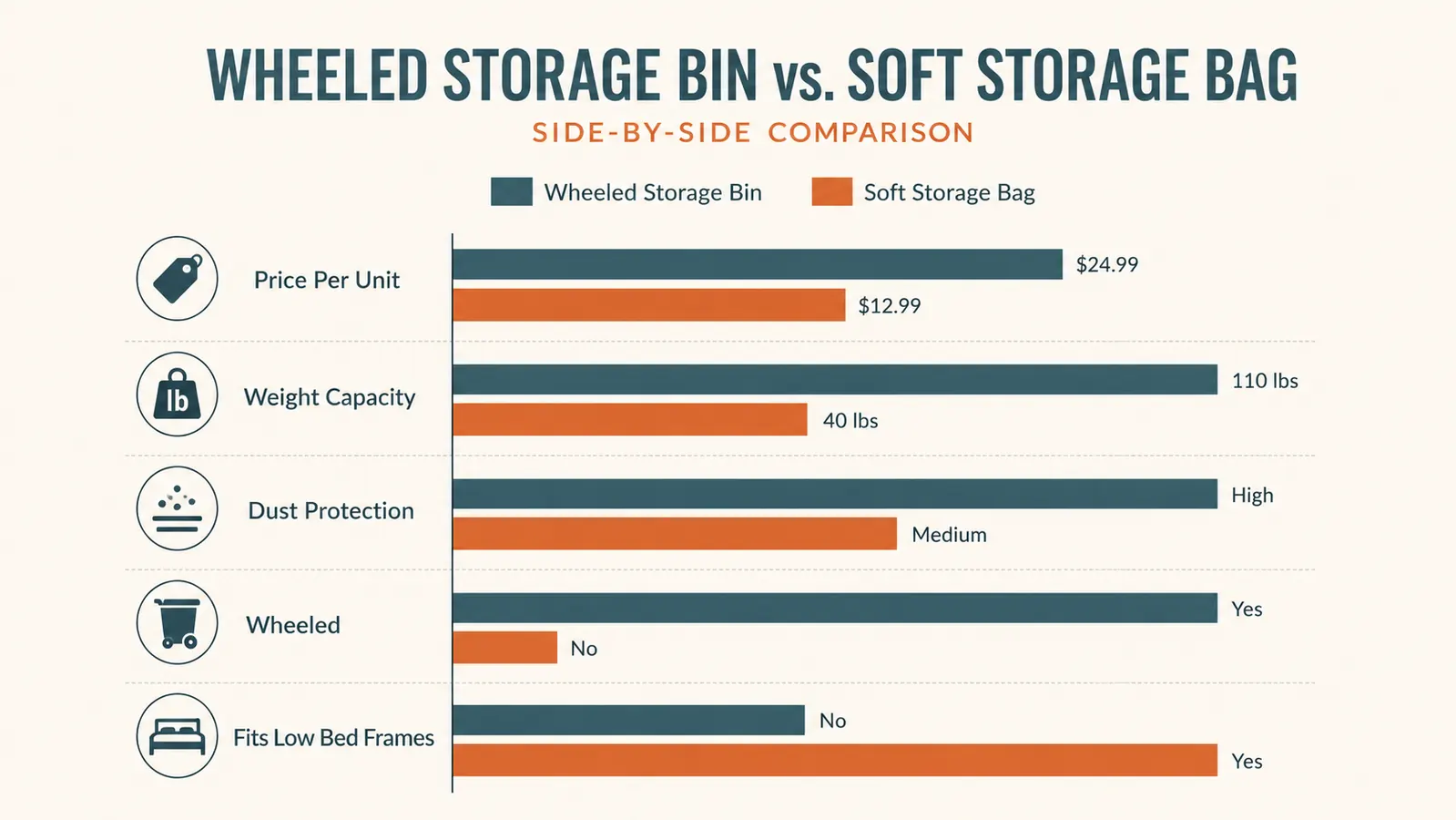
Dust, Pests, and Moisture: The Real Test
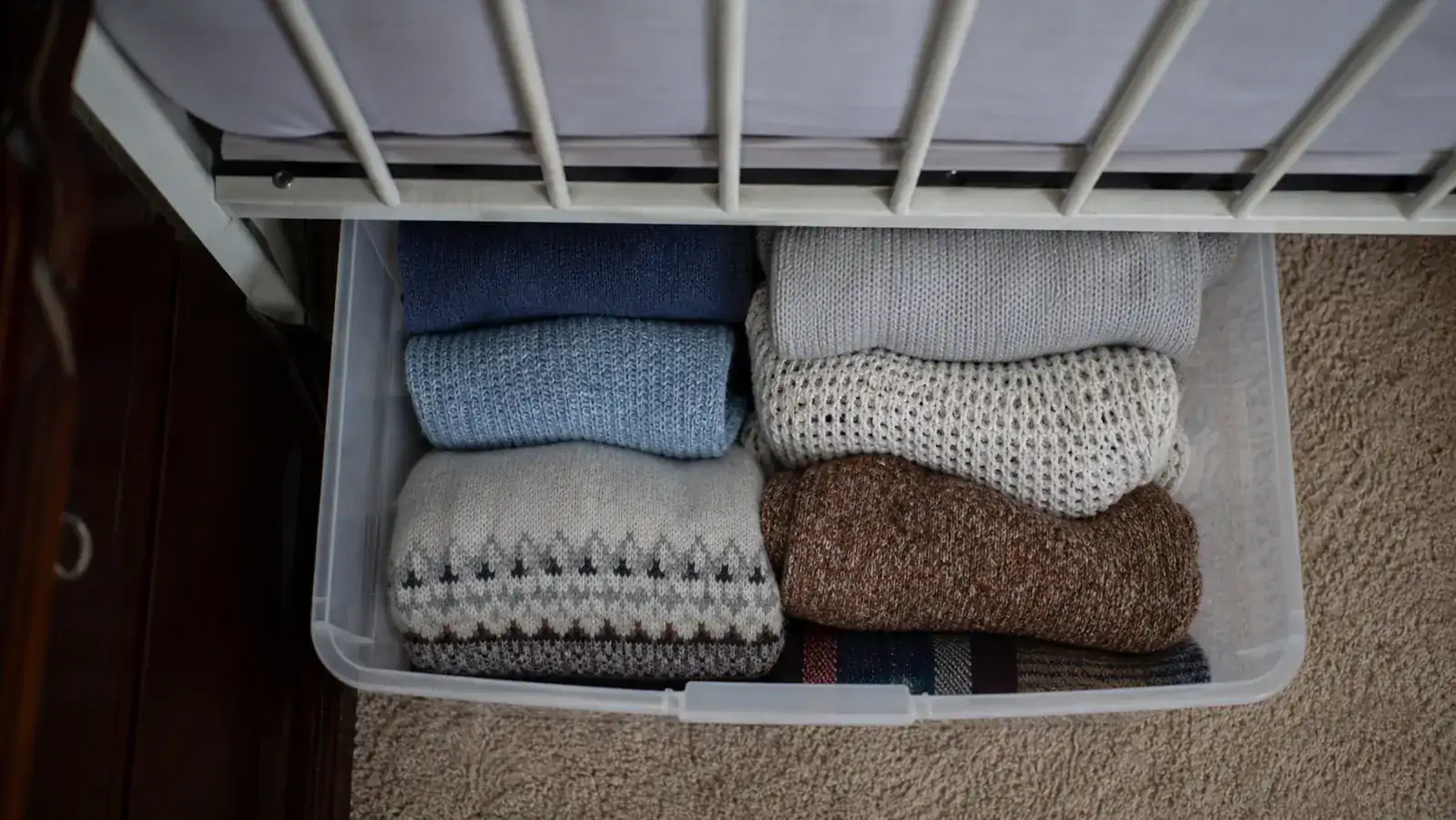
This is where the category gap is widest and where I got the most surprised. I keep a set of wool sweaters in one of the bins specifically because wool draws moths, and after checking monthly through a full spring I never found a single sign of damage. The latching lid doesn't create an airtight seal, it's not a vacuum bag, but it's tight enough that nothing was crawling in from the outside. A neighbor who stores similar items in soft bags in her basement found moth damage in one bag two seasons running, and when we compared notes the difference was obviously the seal, not the storage location, since our two houses aren't that different.
Moisture is a closer call. Neither system is fully waterproof, and if your under-bed storage is in a basement or a room prone to humidity, plastic bins don't magically solve that, condensation can still build up inside a closed lid on a muggy week. What the bin does solve is the slow creep of everyday dust and the occasional splash from a spilled glass of water near the bed, both of which soft bags soak straight through and pass on to whatever's packed inside.
Noise, Floors, and Everyday Handling
Nobody mentions this part, so I will: the wheels roll fine on carpet, but on our hallway's hardwood, a fully loaded bin has a noticeable rumble that soft bags obviously don't produce, since you're carrying or dragging those instead. If you're pulling storage out late at night while someone's asleep down the hall, that's worth knowing. It's not loud enough to bother anyone through a closed bedroom door, but it's not silent either, and I'd rather flag it than have you discover it at 11pm.
On handling day to day, the bin's latches take an extra two or three seconds to pop open compared with a zipper, which sounds trivial until you're doing it in a hurry looking for one specific pair of gloves. The tradeoff is that those same latches are exactly why nothing shifts loose or spills out when you're rolling the bin across an uneven floor. A soft bag's zipper is faster to open but also the first thing to fail after repeated use, since it's carrying tension the whole bag's shape depends on.
Price and Long-Term Value
On a straight per-unit basis, soft bags are cheaper, often half the price of a bin. If you only need storage for a single season and don't mind replacing bags every year or two as the seams wear out, that lower upfront cost might be the right call for your budget. I'm not going to pretend a bin four-pack is the cheaper option on day one at today's price, because it isn't.
Where the math flips is replacement. I've bought soft storage bags three separate times over the years because the bottoms eventually split or the zippers fail. The bins I'm using now show no structural wear after ten months of regular use, and Sterilite's clear latching totes have a long track record of lasting five-plus years under normal household use. If you're the kind of household that stores the same off-season items every year without fail, and most of us are, the bin pays for itself in avoided replacement purchases within two or three seasons.
Who Should Buy Which
Get the wheeled bin if your bed frame clears at least 6 inches, you're storing anything you care about protecting (wool, leather shoes, guest bedding, photos or keepsakes), or you're tired of a system that requires two hands and a bent back to drag out every season. If that's you, this is the same product I go through in more depth in the 10-month long-term review and the honest review covering clearance and wheel-noise surprises, both worth a read before you order.
The bin isn't fancier storage. It's storage that still works the same way two years later, which is the only test that actually matters.
Stick with soft bags if your bed frame has less than 6 inches of clearance, you're storing lightweight seasonal items you don't mind replacing occasionally, or you need something that folds away completely when it's empty. If floor-space flexibility matters more to you than a hard seal, that's a legitimate reason to choose fabric, just budget for replacing the bags sooner than you'd replace a bin. For a broader look at what wheeled bins solve beyond just clearance, this rundown of ten reasons they reclaim bedroom floor space covers cases I didn't get into here.
Stop Repacking a Bag That Splits Every Other Season
If your bed frame clears at least 6 inches, the wheeled bin is the version of this you only have to buy once. Check today's price on Amazon and see the current 4-pack listing.
Amazon Check Today's Price on Amazon →