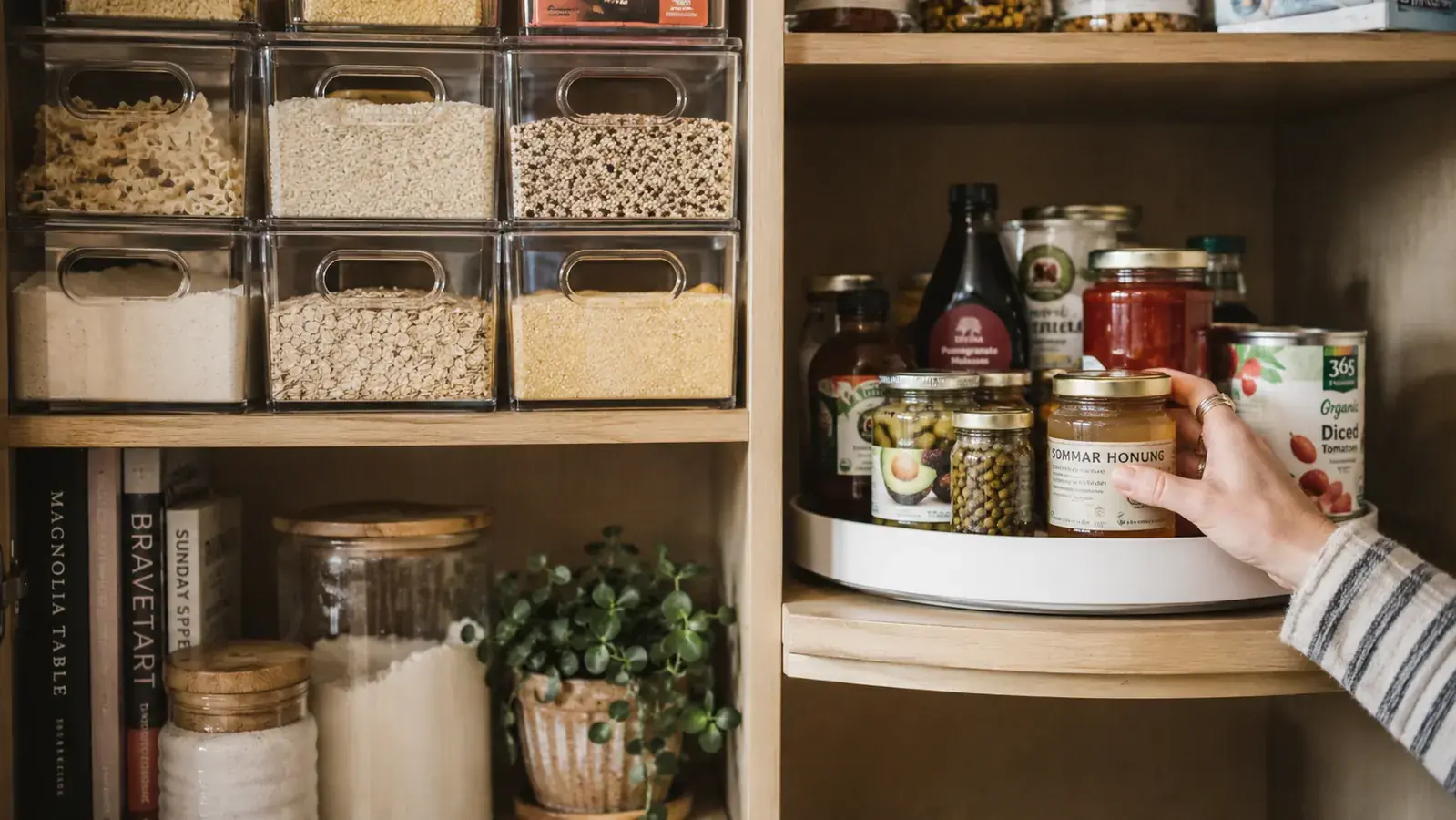
My friend Marisol texted me a photo of her pantry shelf at 9:40 on a Tuesday night. Three opened bags of pasta, a trail of spilled quinoa, and a box of crackers wedged sideways behind an economy tub of oatmeal. She had just bought a rotating lazy Susan turntable because a home makeover video made it look like magic. Three weeks later, half the shelf still would not spin freely, because a turntable only works if everything sitting on it is round enough, or short enough, to actually rotate past the boxes stacked next to it. That's the gap nobody mentions before you buy one.
I have spent nine months running two systems side by side, a six pack of YIHONG clear pantry storage bins on one shelf and a two tier rotating turntable on the shelf next to it, in my own kitchen and in Marisol's. Same brands of cereal, same overflow of snack bags, same eight year old, her daughter Ivy, grabbing breakfast before school. One of these held up as a daily habit. The other one got quietly moved to a corner cabinet where it actually belongs, and stayed there.
If you want the short answer: the YIHONG bins win for most kitchens, most of the time. A turntable earns its spot in exactly one location, a deep corner cabinet where nothing else reaches the back. Everywhere else, on a standard pantry shelf, in a lower cabinet with mixed height boxes, in the fridge door, the YIHONG bins do more actual daily work. Here's the side by side, then I'll walk through where each one wins and where it quietly lets you down.
| Pantry Storage Bins | Lazy Susan Turntables | |
|---|---|---|
| Typical Price | Budget-friendly for a six pack, low cost per bin | Budget to mid-range for a single two-tier turntable |
| Best Location | Pantry shelves, cabinets, fridge, closets | Deep corner cabinets and lazy-Susan-shaped cabinet inserts |
| Visibility | Clear sides show contents at a glance | Visible only from directly above or once spun into view |
| Access Speed | Grab by the cutout handle, no spinning needed | Must rotate the disc to bring an item to the front |
| Stackability | Bins stack two high without crushing contents | Nothing stacks, items shift off center and tip |
| Cleaning | Lift out, rinse in the sink, dry, done | Wipe the disc in place, awkward around the center post |
| Kid Accessibility | Handle and clear sides make items easy for kids to find and carry | Small kids often spin too hard and knock jars off the edge |
| Cabinet Fit | Fits any standard shelf 12 inches deep or more | Needs a round or corner cabinet with real clearance to spin |
| Item Shape Requirement | Handles bags, boxes, loose items, and jars equally well | Works best with round bottles and jars, boxes jam the rotation |
Where the YIHONG Bins Win
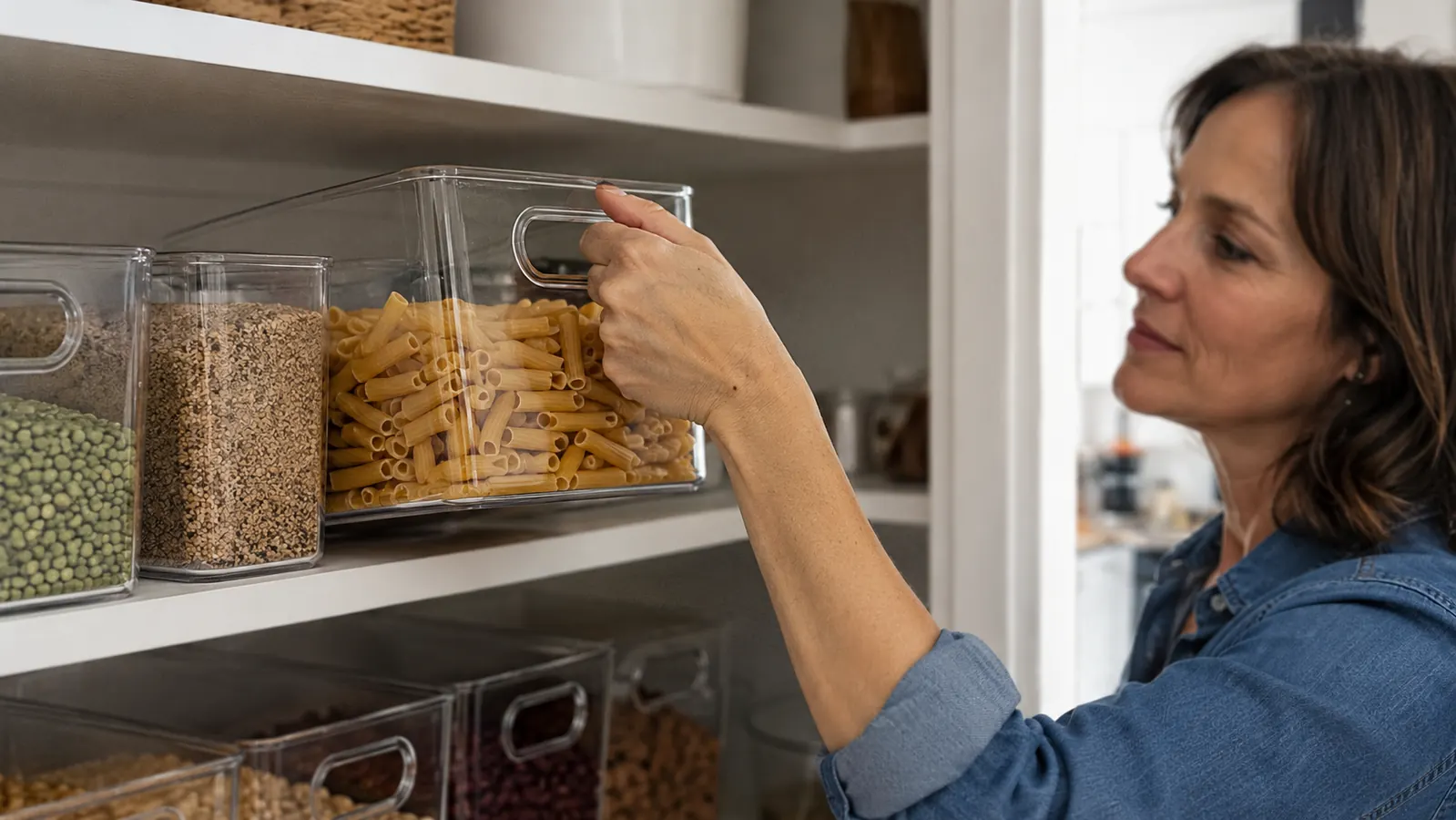
In Marisol's kitchen, the YIHONG bins went in on the shelf directly across from the turntable, and within a week Ivy stopped asking where the granola bars were. That's not a small thing when you have an eight year old who used to dig through three shelves before she found the right snack. The clear sides mean a kid, or a tired adult at 6 a.m., can see exactly what's in a bin without pulling it out and setting it back crooked. A turntable only shows you what's rotated to the front, so you're either spinning blind or lifting the whole thing to check what's stacked behind it, which mostly nobody does.
The YIHONG bins also stack, which matters more than it sounds like it should. On my own pantry shelf, two bins sit stacked on top of each other holding baking staples on the bottom and snack mix on top, and neither one shifts or crushes the other. Nothing about a turntable stacks. It's a flat disc, so whatever fits on that one plane is all you get, and anything taller than the shelf above it simply doesn't fit at all. If you want the full nine month breakdown of how these bins actually held up to daily grabbing, drops, and a dishwasher run every few weeks, I wrote it all up in my long-term pantry storage bins review.
There's also a shelf math argument in the bins' favor that took me a while to notice. Because they're rectangular and pack edge to edge, six bins on a standard 30 inch pantry shelf leave almost no dead space. A turntable, being round, wastes the four corners of whatever shelf it sits on, space that a bin would use but a spinning disc simply can't. On a shelf that's already tight, that wasted corner space adds up to enough room for another whole bin or two, which is exactly the kind of detail that decides whether a pantry actually holds everything a family needs or forces you to keep a second overflow bag on top of the fridge.
Where a Lazy Susan Turntable Wins
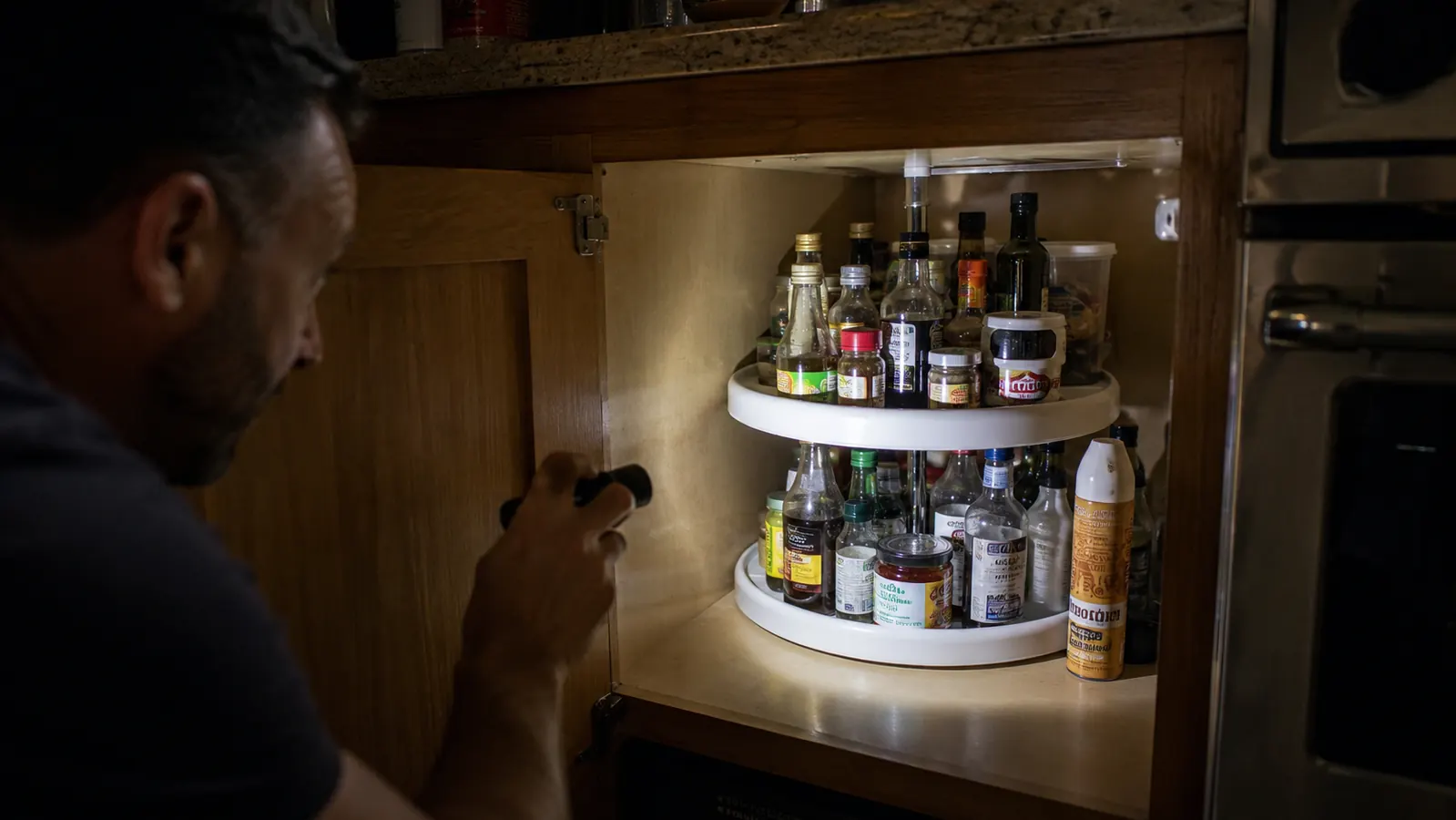
I'll give the turntable its due, because it does solve one problem the bins genuinely can't touch. Marisol's kitchen has a deep corner cabinet, the kind where the back third of the shelf is basically a black hole you need a flashlight and a long arm to reach. Before the turntable, a jar of coconut oil sat back there for over a year, forgotten, until she found it during a full pantry teardown. Her husband Denny put the turntable in that exact cabinet, loaded it with oils, vinegars, and a few condiment bottles, and now a half spin brings anything in that cabinet within easy reach. No bin, no matter how good the handle is, fixes a cabinet that's three feet deep with a door that only opens 18 inches wide.
The catch is that this win is narrow. It only works this well because everything on it is round, jars and bottles that actually roll smoothly along the disc without catching an edge. The moment you put a rectangular cereal box or an oddly shaped bag of rice on the same turntable, it jams the rotation or slides off center the first time someone spins it too fast. I've watched a box of pasta knock three spice jars off Marisol's turntable in one careless spin. That never happens with a bin, because nothing on a shelf full of bins is trying to rotate in the first place.
Nine Months, Two Kitchens: What Actually Changed Daily Habits
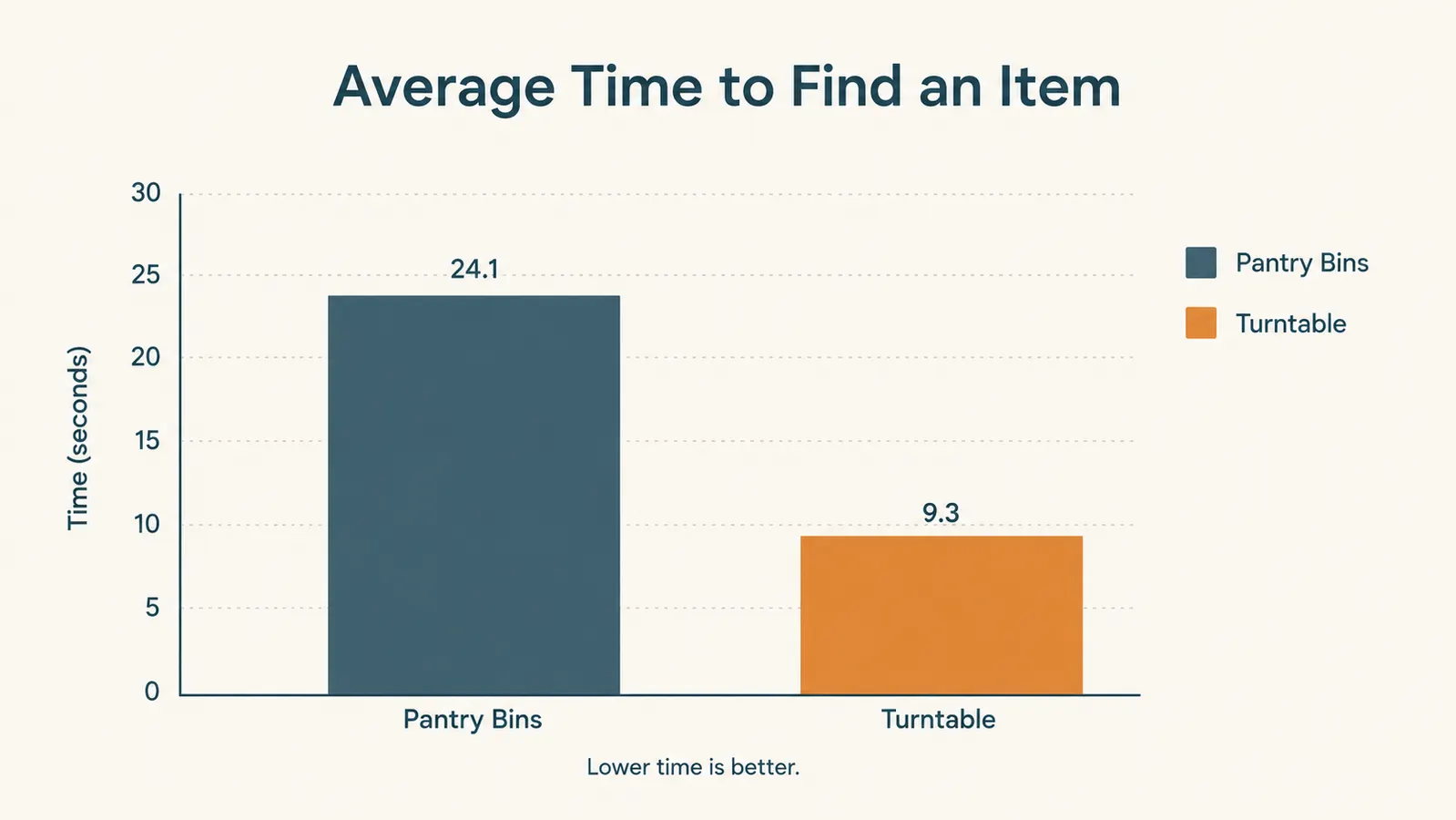
I didn't just glance at both setups and call it a comparison. I tracked how each one performed for roughly the same task each week: how fast someone could locate and grab a specific item, and how often that item ended up back in its spot afterward instead of left out on the counter. With the bins, both in my kitchen and Marisol's, that grab-and-return cycle averaged well under ten seconds once everyone knew the layout. Clear sides mean you don't have to guess, and a handle means you don't have to wrestle a heavy box out from between two others.
The turntable told a different story depending on what was loaded onto it. For the corner cabinet oils and condiments, it performed close to the bins, a quick spin and the bottle you want is right there. But on the one shelf where Marisol first tried it, mixed in with boxed pasta and cereal, it slowed everyone down. Ivy would spin it looking for cereal, overshoot, spin back, and eventually just start pulling boxes off entirely to find what she wanted, which is the exact chaos a turntable is supposed to prevent. The lesson took us both a while to accept: a turntable isn't a general pantry fix, it's a specialist tool for one specific cabinet shape, and using it anywhere else usually backfires.
Cleaning, Spills, and What Nine Months of Kitchen Life Does to Each One
Spills happen in every kitchen, and this is where the two systems really part ways for me. When a bin gets sticky, from a leaking honey bottle or a torn cereal bag, I lift it out, rinse it in the sink, and dry it in about ninety seconds. The shelf underneath stays clean because the bin caught the mess in the first place. The turntable can't be lifted out as easily, especially once it's loaded with a dozen jars, so a spill on the disc means unloading everything, wiping the surface around a center post that catches crumbs and dried liquid, then reloading. I've done it, and it's a ten minute job compared to the bin's ninety seconds.
Cabinet fit is the other thing worth measuring before you buy either one. The bins are forgiving, they just need enough shelf depth, which is 12 inches or more for most standard pantries and lower cabinets. A turntable needs actual spin clearance on every side, which means measuring the full diameter of the disc plus a little breathing room, not just the width of the cabinet opening. Marisol tried squeezing a 12 inch turntable into an 11 inch deep cabinet before the corner cabinet worked out, and it never spun a full rotation without catching on the door hinge. Measure first, especially for a turntable, because a disc that can't complete a full spin is barely better than a shelf that doesn't move at all.
Stop Losing the Back of the Shelf to Guesswork
The YIHONG six pack keeps everything visible and grabbable from the front of the shelf, so nobody in your kitchen has to spin, dig, or move three boxes to find the one thing they actually want.
Amazon Check Today's Price on Amazon →Who Should Buy Which
Buy the pantry bins if your problem is a standard pantry shelf, a lower cabinet, or an open shelf that's collecting loose bags, boxes, and mismatched containers. That's most kitchens, and it's the shelf that gets opened dozens of times a day by whoever's making breakfast, packing lunches, or grabbing a snack before practice. For the fuller case on why bins specifically beat the alternatives most people reach for first, our 10 reasons clear pantry bins fix kitchen clutter piece walks through it in more detail. Buy a turntable if, and only if, you have one specific deep corner cabinet where items regularly disappear toward the back and everything you'd store there is genuinely round, bottles, jars, and cans. Outside of that one cabinet shape, a turntable usually ends up half used and eventually shoved to the side, the way Marisol's almost did before Denny relocated it to the one spot it was actually built for.
If you're not sure which situation you're in, open your pantry and count how many items on the problem shelf are round versus boxed or bagged. If most of what's crowding that shelf is cereal, pasta, snack bags, and flour, you're a bins household. If the actual mess is a deep, awkward corner cabinet stuffed with bottles you keep forgetting about, that's a turntable's one real job, and it does it well. Most kitchens I've worked in end up using both, bins up front where they're seen daily, a turntable tucked into the one cabinet that swallows everything else. Neither one is a status symbol. They're both just tools, and the right tool depends entirely on the shape of the space you're trying to fix.
The Shelf Marisol Wishes She'd Started With
Before you spend money on a spinning disc that only works for round jars, try the setup that handles everything on a normal pantry shelf, boxes, bags, and loose snacks included.
Amazon See Current Price on Amazon →