
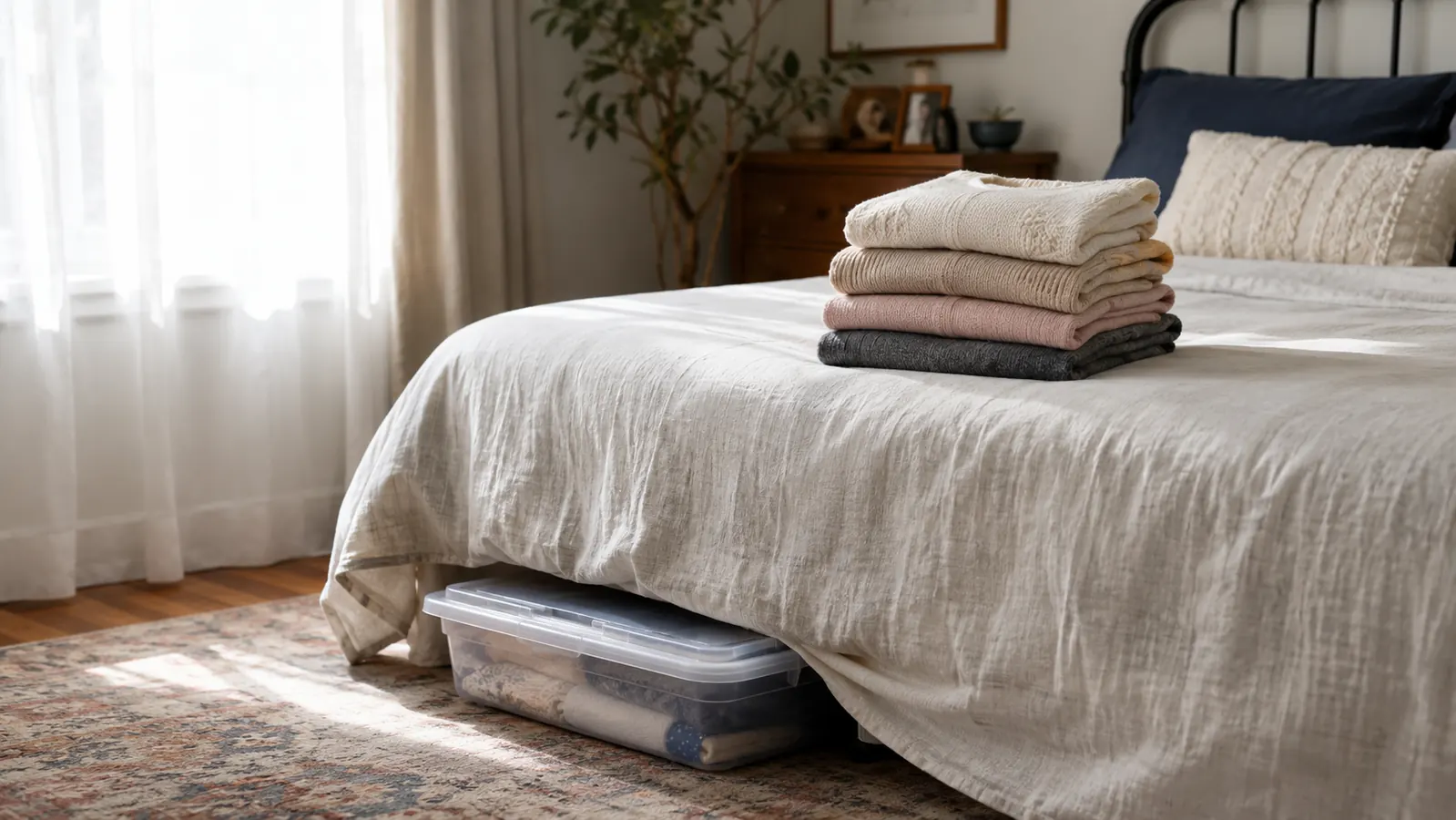
Every October I have the same conversation with myself. The closet rod is jammed with tank tops I have not touched since June, there is a parka draped over the desk chair because it would not fit anywhere, and somewhere under a pile of "maybe later" is the sweater I actually want to wear that day. That was my house for about six years, until I finally accepted that my closet was never going to hold every season at once, and it did not need to. It needed a place to send the clothes that were not in rotation. For me that place turned out to be a set of Sterilite wheeled under-bed bins, four of them, clear so I can see what is inside without opening a single one.
This is not a theory piece. I have run this exact system for three winter-to-summer swaps now, in a bedroom with a standard queen frame and about six inches of clearance underneath. What follows is the actual method, step by step, including the two mistakes that cost me a ruined cardigan the first year I tried it.
Under-bed storage works because it uses square footage nobody else wants. That space under the frame is dead space in most houses, collecting dust bunnies and the occasional lost sock, until you turn it into the second closet you actually need. You don't need a spare room or a rented storage unit down the road, you need four bins and about an hour on a Saturday morning.
The bin that started this whole system
Four wheeled, latching, clear under-bed bins from Sterilite are what made off-season rotation actually stick in my house. Check today's price on Amazon before you buy anything else for this project.
Amazon Check Today's Price on Amazon →Step 1: Sort Before Anything Goes in a Bin
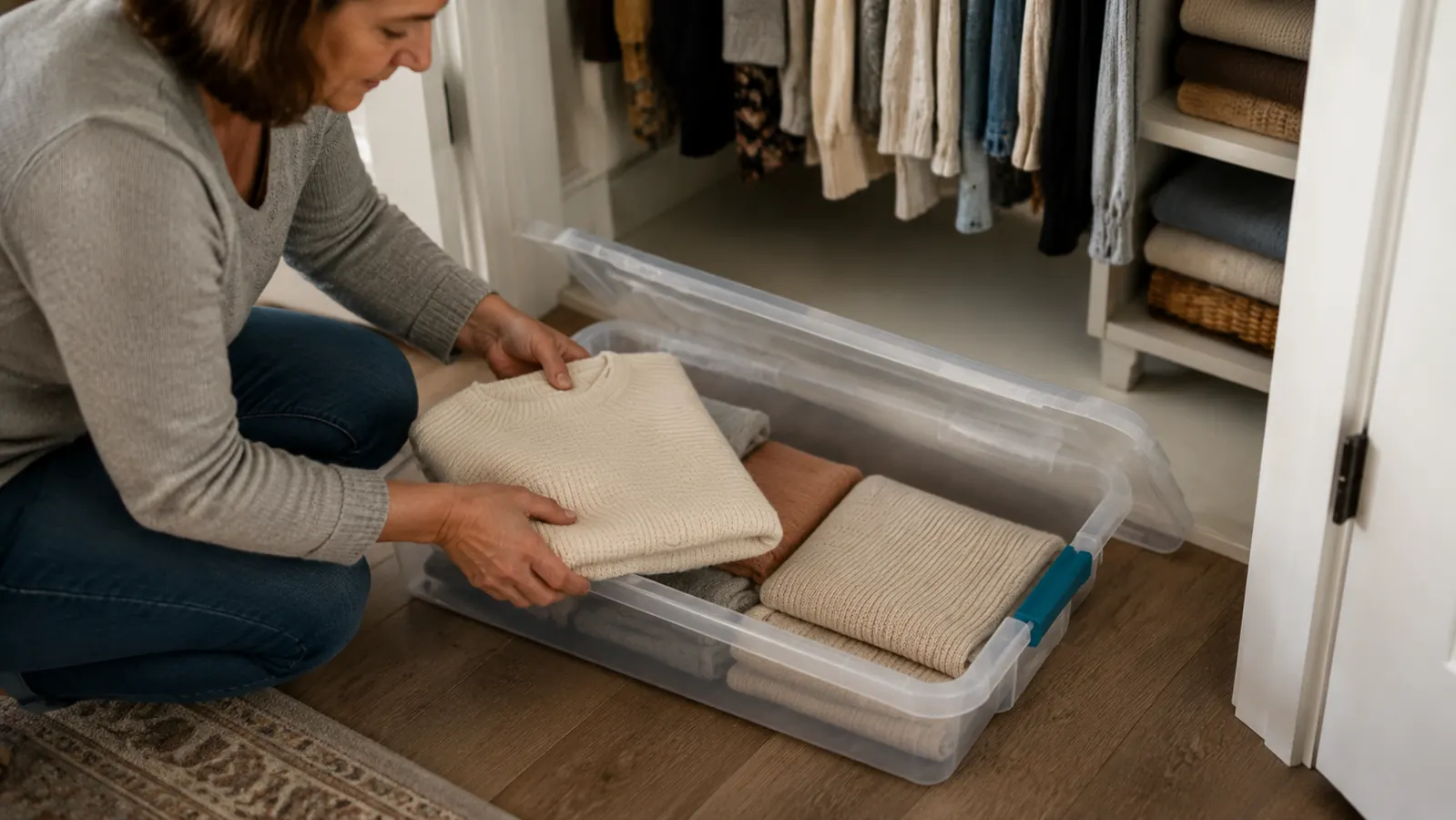
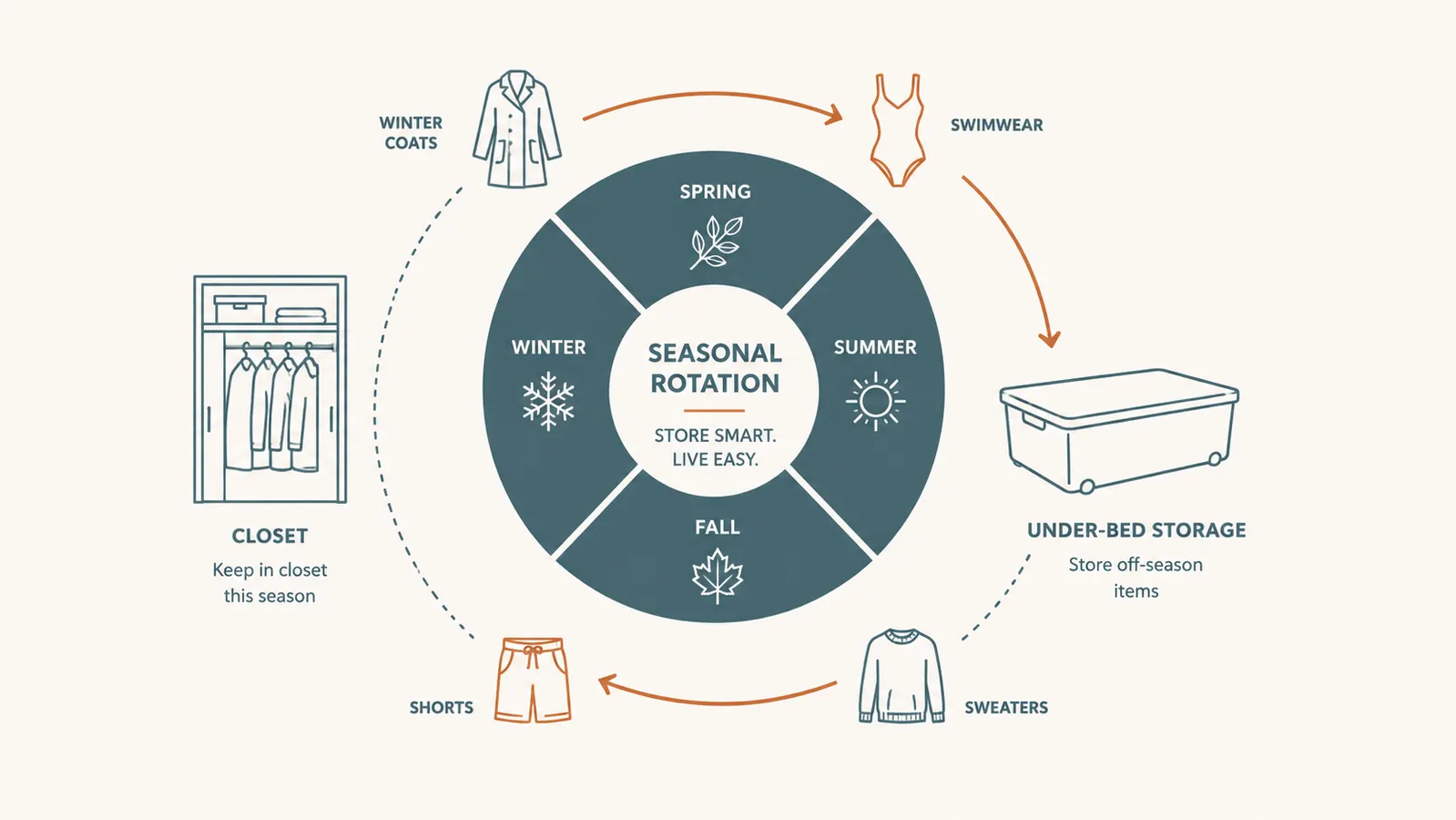
Skip this step and you will just be storing clutter more neatly, which is not the same as fixing anything. Pull every off-season item out of the closet and dresser and lay it on the bed. For me that is winter coats, wool sweaters, snow pants, and heavy scarves in April, and shorts, tank tops, and sandals in October.
Sort into three piles as you go: keep and store, keep and wear soon (this stays in the closet), and donate. I am ruthless about the third pile now. If a sweater sat in a bin untouched for a full year, it is not coming back into rotation, it is going to donation. My neighbor Theo does this same sort twice a year with his kids' clothes and swears the donate pile is always bigger than he expects, which tracks with mine too.
Wash or dry-clean everything before it goes into storage, even things that look clean. Body oils and faint sweat residue you cannot see are exactly what draws moths and yellows fabric over months in a sealed bin. This is the step people skip and regret.
Give yourself an honest fit check while everything is out on the bed too. Kids grow between seasons, and I have pulled winter coats out of storage that fit a child perfectly in November and stopped fitting by February. If something is close to being outgrown, it goes in the donate pile now rather than getting packed away for a season it will never see again.
Step 2: Pick a Bin That Actually Fits Under Your Bed
Not every storage bin is an under-bed bin. Standard totes are usually too tall to clear a bed frame, which means you either can't slide them all the way in or you crack the lid trying to force it. Measure the clearance from your floor to the bottom of your bed frame or box spring first, most standard frames give you six to seven inches, platform beds often give you less.
The Sterilite bins I use run low and long by design, made for this exact job, with wheels on one end so you are not dragging a loaded bin across hardwood or, worse, carpet. The latching lids matter more than they sound like they would. A bin without a real latch pops open the first time you drag it out with any speed, and I learned that with a lid that popped and dumped folded sweaters across the bedroom floor two years ago. Clear plastic over opaque is worth paying attention to as well, because you want to identify the right bin at a glance in February without pulling out three of them first. If you want the longer version of how these specific bins have held up over ten months of use, I wrote up the full breakdown in my long-term review of these under-bed bins.
Capacity is worth thinking through before you buy, not after. A single 56-quart bin holds roughly six to eight folded sweaters plus a couple of scarves comfortably, more if you're storing lighter summer clothes. Four bins gave my household of two adults enough room for both of our winter rotations plus one bin dedicated entirely to summer swim gear, which we used to keep in a duffel bag in the garage that never once stayed dry.
Step 3: Fold and Pack to Protect the Fabric, Not Just Save Space
How you pack matters more than how much you pack. Fold sweaters flat rather than rolling them if you are storing them for months, rolling is great for a suitcase over two weeks, but it creates permanent crease lines in wool and cashmere over a full season. Heavier items like coats and snow pants go on the bottom, lighter knits on top, and I leave the Sterilite bin at about eighty percent full rather than packed to the lid. Overstuffing compresses fibers and makes the latch fight you every time.
Add a moisture absorber, not mothballs. I use a small silica packet in each bin and swap it each season, mothballs leave a smell that lingers in fabric for months and honestly makes clothes worse to wear once you pull them back out. A cedar block does double duty as a moth deterrent without the chemical smell, and it is what I switched to after the mothball experiment my first year, which was a mistake I do not repeat.
One thing I learned the hard way: never store anything even slightly damp. I once packed a rain jacket that felt dry to the touch but had a bit of dampness trapped in the lining, and by the time I opened that bin five months later there was a faint mildew smell that never fully came out. Air dry everything for a full day past when it feels dry before it goes in the Sterilite bin.
Small accessories deserve their own layer instead of getting tossed in loose. I use a thin drawstring bag for gloves, hats, and belts and set it on top of the folded clothes so it doesn't shift around and dig into anything underneath. Shoes go in their own bin entirely if you have the room, stuffed with tissue paper to hold their shape, since packing boots in with soft clothing tends to crush whatever they're sitting on.
Step 4: Label and Load in the Order You'll Need Things
With four bins under one bed, you need a system or you will be pulling all four out to find one scarf. I label each bin on the short end, the end that faces out when it's under the bed, with a strip of painter's tape and a marker: Winter Coats, Winter Sweaters, Summer Tops, Beach and Swim. Clear bins make this almost unnecessary for identifying contents, but the label saves you from reading through plastic at a glance in dim light.
Load the Sterilite bin you will need first closest to the accessible end. In my house that is the coat bin in fall and the tank top bin in spring, because those get pulled the moment temperatures shift, while snow pants and swimwear come out weeks later. This sounds small, but it is the difference between a thirty second grab and dragging out every bin on a Tuesday morning when you are already running late.
If more than one person in the house pulls from these bins, a shared system beats a personal one. My husband and I split our four bins by category rather than by person, since neither of us wants to remember whose bin is whose, we just want to remember what's in it. Whatever labeling logic you pick, keep it consistent bin to bin or the whole point of labeling disappears.
Step 5: Roll Them In and Set a Rotation Reminder
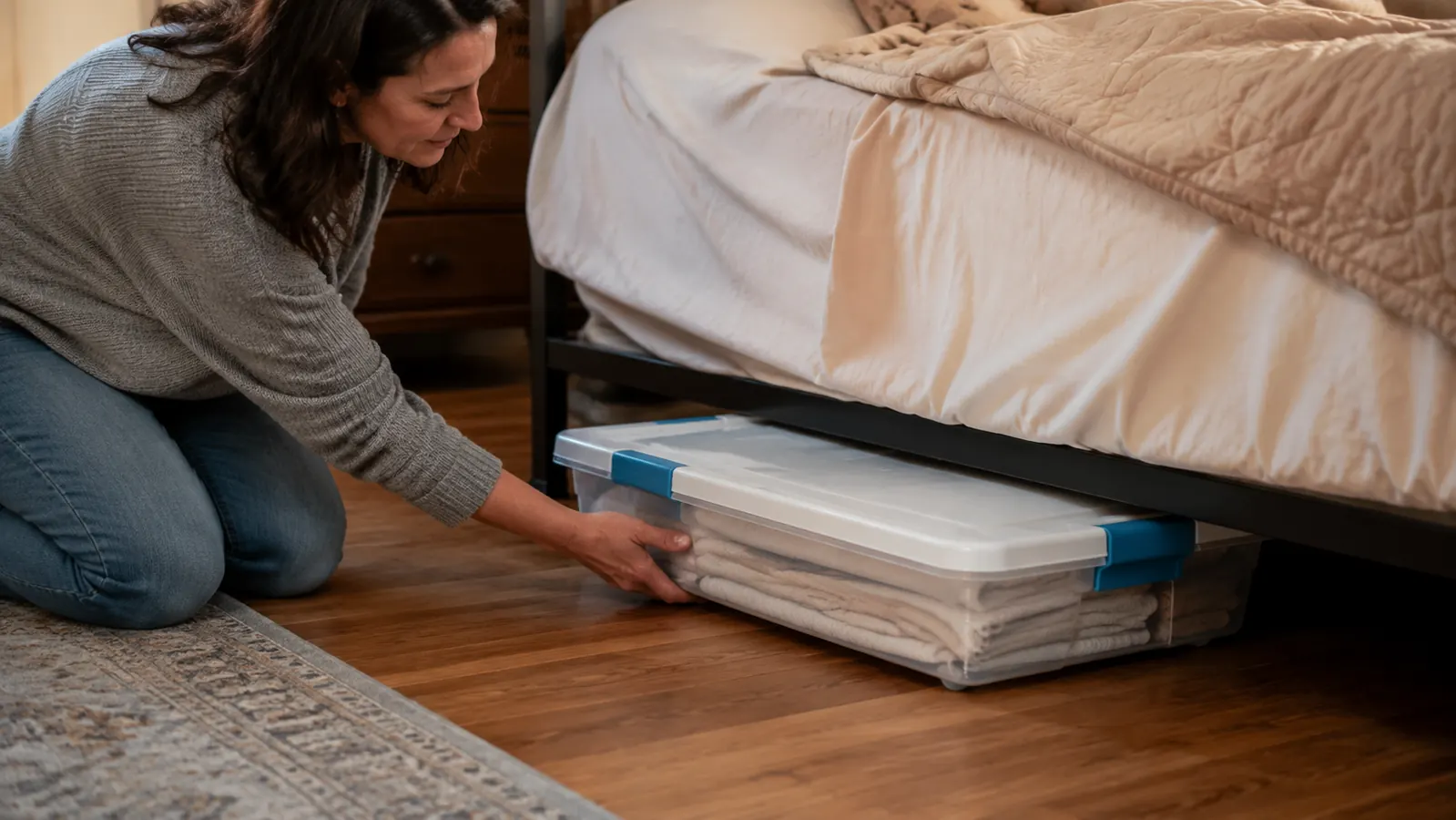
Slide the bin in wheel-end first if your bed skirt or frame has a tight clearance, so you are pulling rather than pushing on the return trip. Push it flush against the headboard wall side so it is not blocking the space you need to get in and out from the other side of the bed.
Set an actual reminder on your phone for the swap, not a mental note. I do the first weekend of April and the first weekend of October, tied loosely to when the furnace or air conditioner switches over in my house, since that is already a seasonal marker I do not forget. When the reminder hits, the whole swap takes me under twenty minutes now that the system is dialed in, compared to the ninety minutes of digging through boxes it used to take before I had a real bin system.
The swap itself is where the wheels actually earn their keep. Pulling a fully loaded bin out from under a low bed frame by dragging it flat on the floor is a two-person job or a bad-back job, but rolling it out on its own wheels is something I do solo in under a minute, even loaded with a winter's worth of coats and sweaters.
What Else Helps
A few small additions make the system run smoother without adding real cost or effort. Slim under-bed bags work fine for soft items like extra bedding you are storing alongside the clothes, but they are a poor substitute for the clothes themselves since they don't protect against crushing the way a hard-sided bin does, and they're harder to slide on wheels or carpet. If you are trying to decide between the two approaches for your own space, I ran both side by side for a season and wrote up exactly where each one wins in this comparison of bins versus soft storage bags. A bed skirt or a simple fabric valance also hides the bins from view entirely, which matters if your bedroom doubles as a guest space or you just don't love looking at plastic edges from the doorway.
A furniture-grade felt pad or a set of caster cups under the bed legs also protects hardwood floors from the extra weight rolling in and out twice a year, something I wish someone had told me before I noticed the faint wheel tracks on our floor the first winter.
The system only works if grabbing the right bin takes less effort than leaving the coat on the chair. That's the whole test.
Ready to actually clear the closet floor?
This whole method only works with bins that fit your bed frame's clearance and latch shut when you drag them. See current availability and price for the Sterilite wheeled under-bed set on Amazon.
Amazon Check Today's Price on Amazon →